
Quick answer
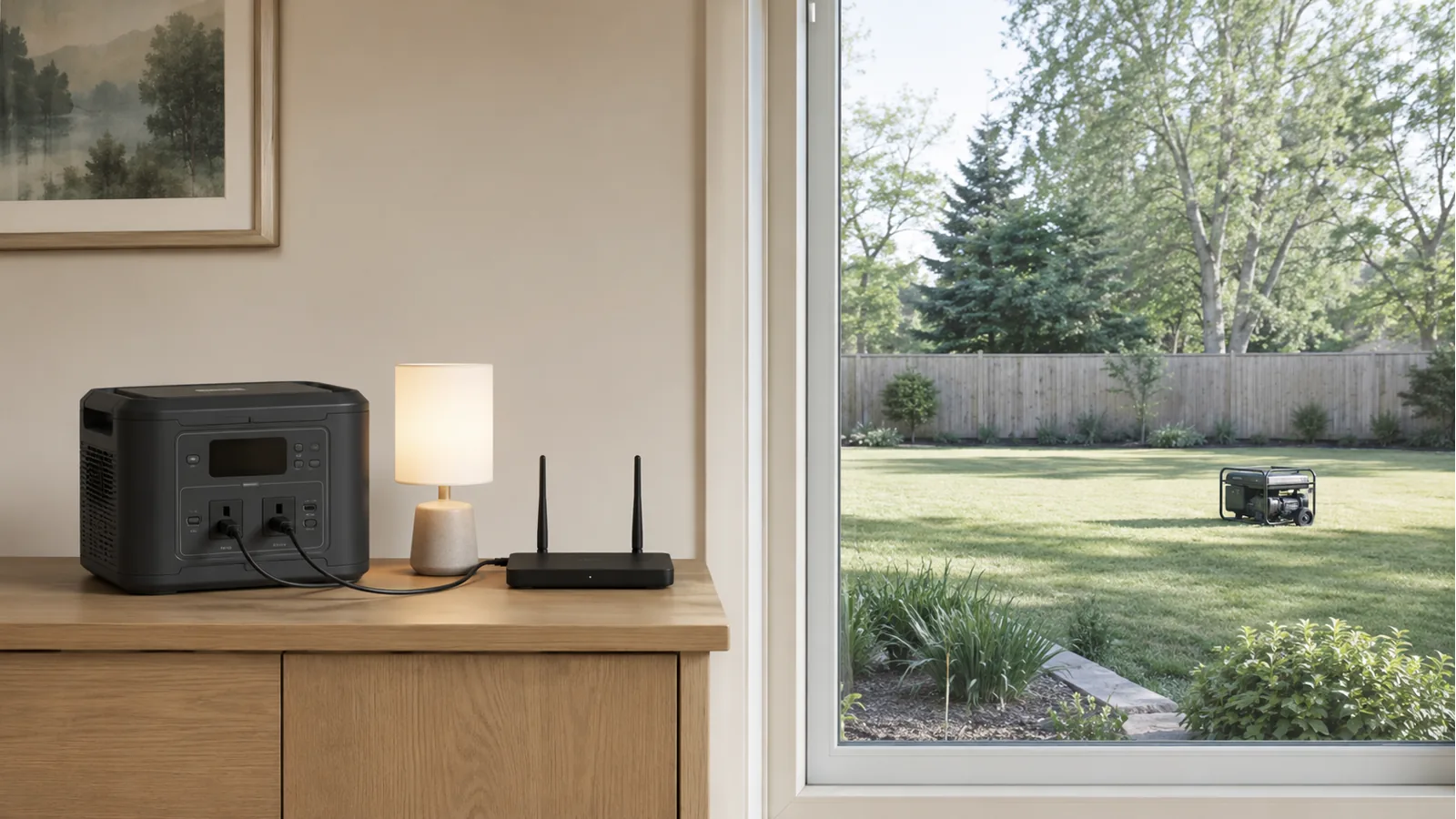
A portable power station and a fuel-powered portable generator solve the same broad problem—temporary electricity during an outage—but their feasibility gates are different.
A fuel generator is not a candidate unless the household can operate it outdoors, at least 20 feet from homes and buildings, direct the exhaust away from doors, windows, and vents, keep it dry, use it without backfeeding, store and handle fuel lawfully and safely, and follow the exact manual. If a renter or apartment resident cannot meet those conditions, the fuel-generator branch stops before product shopping.
A battery power station does not create toxic combustion fumes, according to current EPA outage guidance, so it may remain a candidate where fuel combustion cannot. That narrower advantage does not make every battery station safe, permitted, powerful enough, compatible, or suitable indoors. The exact unit, charger, condition, placement, load, storage route, building rules, and battery-safety checks still matter.
Neither category wins by default. Start with the required delivered energy, simultaneous continuous power, and startup event from the essential-load sizing workflow. Then apply the portable power station safety gate, the capacity and runtime claims guide, and the portable power station feature-fit guide. If no category can meet the location, safety, load, replenishment, and emergency-plan constraints, “neither yet” is a valid result.
Comparison at a glance
| Decision dimension | Battery power station | Fuel-powered portable generator |
|---|---|---|
| Combustion exhaust | Does not create toxic combustion fumes, but battery, charger, placement, and condition risks remain | Produces combustion exhaust including carbon monoxide; outdoor placement and exhaust direction are hard gates |
| Location | May be usable indoors only when the exact manual, condition, charging/storage site, and building rules permit | Outdoors only, at least 20 feet from buildings/openings under current U.S. guidance |
| Energy replenishment | Starts with stored electrical energy; needs a viable recharge or replacement-energy plan | Starts with a fuel supply; needs permitted storage, safe refueling, and a resupply plan |
| Output and startup | Exact model must meet essential-load continuous and startup requirements | Exact model must meet essential-load continuous and startup requirements |
| Runtime | Depends on exact usable energy, output path, load, conditions, and recharge plan | Depends on exact tank, fuel, load, operating conditions, refueling, and maintenance |
| Weather | Exact station/charger manual controls; wet or damaged electrical equipment is a stop condition | Exact manual controls wet-weather use; current CPSC/OSHA guidance requires shock precautions and keeping the generator dry |
| Noise | Exact product and load conditions control; fans may operate | Engine noise is a material placement and neighbor constraint; compare exact declared or measured conditions |
| Maintenance | Charging, storage, condition, recall, and battery warning-sign checks | Regular engine/generator checks, fuel handling, cool-down before refueling, and exact manual maintenance |
| Home circuits | Temporary plug-in use only in this article | Temporary plug-in use only in this article; direct structural connection requires a separate qualified integration route |
| Best fit | A candidate when location, load, stored energy, charging, and safety constraints pass | A candidate only when outdoor placement, fuel, load, weather, maintenance, and safety constraints pass |
This table does not rank categories. Each cell is a gate or a question to verify.
Start with the foundation, not the fuel type
Do not compare generator categories until the earlier decisions are complete:
- Readiness: identify essential outage needs, building access, storage, charging, permission, and no-purchase alternatives in the renter-readiness checklist.
- Claims literacy: understand W, Wh, usable energy, continuous output, surge, and runtime boundaries in the capacity and runtime claims guide.
- Safety: check recalls, condition, charging, placement, backfeeding, and stop-use conditions in the portable power station safety guide.
- Product-family fit: decide whether a carryable, expandable, wheeled/high-output, or UPS/EPS-oriented family fits in the buying guide.
- Sizing: record delivered load energy, simultaneous continuous output, and one-load startup events in the essential-load sizing workflow.
If any of those steps is unresolved, a category verdict is premature.
The fuel-generator feasibility gate
Current CPSC guidance says a portable generator must be operated outdoors, at least 20 feet from homes and buildings, with exhaust directed away from windows, doors, vents, and entrances. Opening a garage door or window does not make indoor or semi-enclosed use safe.
For a renter, apartment dweller, or small-home household, verify all of the following before keeping a fuel generator on the candidate list:
- a compliant outdoor operating location actually exists;
- the lease, property rules, local authority, and emergency plan allow the proposed storage and operation;
- exhaust cannot be drawn into your home or another building;
- a working battery-operated or battery-backup carbon-monoxide alarm is in the occupied space;
- the exact generator can be kept dry and used according to its wet-weather instructions;
- the required loads can be connected through approved cords within the exact ratings;
- the generator will not be connected to residential circuits through backfeeding;
- fuel can be stored and handled lawfully and safely;
- refueling can occur only after shutdown and cooling, under the exact manual;
- regular inspection and maintenance can be performed;
- noise and neighbor constraints are acceptable for the exact placement and operating condition.
If the location cannot satisfy the outdoor-placement rule, stop. A fuel generator is not a practical apartment workaround.
The battery-station feasibility gate
EPA’s current outage guidance distinguishes battery or solar power stations from fuel generators because they do not generate toxic combustion fumes. EPA also describes them as a practical option for some small appliances, lights, and fans.
That does not remove the battery-station gate. Confirm:
- the exact product can meet the essential-load continuous and startup requirements;
- the exact usable-energy or delivered-energy basis is understood rather than inferred from nameplate Wh alone;
- the charging and storage location complies with the exact manual and building rules;
- the product, charger, cords, and accessories are undamaged and not subject to an unresolved recall;
- the equipment shows no odor, unusual heat, deformation, discoloration, leakage, or odd noise;
- the household has a viable recharge path for the outage scenario;
- a finite stored-energy plan is not being mistaken for indefinite backup;
- no premises-wiring, backfeeding, medical-device, or unsupported compatibility claim is being added.
A battery station may be the only category still feasible in an indoor-only scenario, but it can still fail on output, energy, charging, storage, recall, or permission.
Compare replenishment, not just nameplate capacity
The categories replenish energy differently:
- A battery station begins with stored electrical energy. Its continued use depends on the energy already stored and any viable grid, vehicle, or solar recharge path that is allowed and compatible.
- A fuel generator converts a fuel supply into electricity. Continued use depends on fuel availability, permitted storage, safe refueling, exact load, maintenance, and operating conditions.
Neither category offers indefinite runtime. A larger battery does not solve a missing recharge path. A larger fuel tank does not solve an unsafe placement or fuel-storage problem.
Do not compare a battery’s Wh value with a generator’s fuel-tank size as if they were interchangeable units. Use the same declared load scenario, the exact product documentation, and a method appropriate to each energy path. This comparison does not publish a runtime calculator or a universal conversion between battery energy and liquid fuel.
Compare output and starting behavior using the sizing workflow
A category label does not prove that a product can start or run a load.
Carry forward these sizing-workflow outputs:
required delivered load energy in Wh
required simultaneous continuous output in W
one-load startup event in W
startup duration in seconds
Then verify each exact product against its continuous, outlet, combined-output, startup, waveform, temperature, and prohibited-load limits.
Do not:
- add every appliance’s startup claim together without a timing model;
- use surge as if it were continuous output;
- assume a proprietary boost mode is equivalent to normal AC output;
- infer medical-device compatibility;
- connect either category to household circuits through an improvised cord.
If the starting behavior or output requirements remain unknown, the comparison result is “hold.”
Noise, maintenance, and weather are scenario constraints
OSHA treats generators as noisy equipment and recommends distance or barriers where possible. That workplace source does not rank consumer products, but it supports treating noise as a real operating constraint rather than marketing decoration.
For both categories, compare noise only under stated conditions:
- distance from the measurement point;
- load level;
- operating mode;
- enclosure or barrier;
- ambient noise;
- whether the figure is declared or independently measured.
A battery station may operate fans and is not automatically silent. A fuel generator has an engine and may be unacceptable even where the carbon-monoxide placement rule can be met.
Maintenance also differs:
- CPSC says portable generators should be checked and maintained so they work when needed.
- OSHA’s emergency guidance says to shut a generator down and let it cool before refueling.
- USFA advises following battery instructions, storing batteries away from combustibles and direct sunlight, and stopping use when warning signs appear.
The lower-maintenance choice cannot be declared without exact products, storage conditions, use frequency, and owner capability.
Do not treat home-circuit integration as a product feature
This article covers temporary plug-in loads only.
CPSC warns against male-to-male extension cords and residential backfeeding because exposed prongs and energized wiring create electrocution and fire hazards. OSHA guidance says a generator should not be connected directly to a structure’s electrical system unless a qualified electrician has installed the appropriate transfer equipment.
The same boundary applies when a battery product is marketed with home-backup accessories. A 120/240 V outlet, high power rating, transfer feature, or panel accessory does not turn premises integration into a renter DIY task.
If the goal is to energize building circuits, stop this comparison and open a separate property, code, utility, equipment, and qualified-professional project.
Scenario outcomes
Indoor-only apartment, no compliant outdoor site
The fuel-generator branch stops. A battery station may remain a candidate if essential-load output/energy, portable power station safety, charging/storage, condition, recall, and building-rule checks pass. “No purchase” or relocation may still be the better emergency plan.
Detached or small home with a verified outdoor site
Both categories may remain candidates when the site can satisfy the 20-foot and exhaust rules, fuel storage/refueling is permitted, battery charging/storage is feasible, and exact products meet the same essential-load scenario.
The next comparison is not “which category is better?” It is:
- which replenishment path is available during the expected outage;
- which operating and storage burden the household can manage;
- which exact product meets the load without unsupported assumptions;
- whether noise, weather, fuel, charging, maintenance, and access remain workable.
Short, finite outage with small declared loads
A battery station may remain a practical candidate when the stored-energy requirement and recharge plan are explicit. This is not a universal runtime claim.
Extended outage with a reliable, permitted fuel-resupply path
A fuel generator may remain a candidate when outdoor placement, fuel storage, refueling, maintenance, weather, noise, and load checks all pass. This is not proof that a particular generator will run a particular duration.
Medical-device dependency
Do not use a generic category comparison to establish compatibility or runtime. Follow the device instructions and coordinate with the manufacturer or distributor and the appropriate utility, healthcare, fire, or emergency contacts.
Unsafe indoor temperature or inaccessible building
The first decision may be relocation or shelter, not buying a power source. Equipment should support an emergency plan, not delay leaving unsafe conditions.
Need to energize household circuits
Neither branch is resolved by this article. Use a qualified premises-integration route.
The deterministic decision order
The retained comparison method applies gates in this order:
- readiness, safety, and essential-load sizing complete;
- medical-device and unsafe-temperature plans resolved;
- premises-wiring needs routed out;
- fuel-generator outdoor site, permission, fuel storage, and refueling confirmed;
- battery charging and storage site confirmed;
- exact load/output checks retained;
- replenishment paths recorded;
- result classified as battery candidate, fuel-generator candidate, both remain possible, neither currently feasible, or hold for missing facts.
The method never outputs a product recommendation or universal category winner.
Before shortlisting an exact product
Record:
declared essential-load scenario
required delivered energy
required continuous output
startup event and duration
battery charging/storage location
battery recharge path
fuel-generator outdoor placement
fuel permission/storage/refueling path
weather plan
noise constraint
maintenance responsibility
extension-cord and outlet plan
CO-alarm state
building/property/local-authority disposition
premises-wiring requirement
medical-device or unsafe-temperature escalation
no-purchase and relocation alternative
A blank field is not a favorable assumption.
What remains unknown
This guide does not establish:
- the best product or category for every household;
- a product’s real runtime, fuel consumption, delivered energy, noise, emissions, or maintenance cost;
- current prices, fuel prices, rebates, warranties, or affiliate programs;
- whether a lease, building, local authority, or insurer permits a proposed setup;
- whether an exact generator site satisfies every wind, opening, neighbor, weather, or fire requirement;
- whether a battery station is compatible with a particular appliance or medical device;
- whether a transfer switch, interlock, panel, grounding, neutral, or 120/240 V proposal is appropriate;
- a universal greenhouse-gas, air-quality, lifecycle, or cost winner;
- a public runtime calculator.
Those questions require exact products, current local facts, additional methods, or qualified review.
Bottom line
Neither category wins by default. Start with the required delivered energy, simultaneous continuous power, and startup event from the essential-load sizing workflow. Then apply the portable power station safety gate, the capacity and runtime claims guide, and the portable power station feature-fit guide. If no category can meet the location, safety, load, replenishment, and emergency-plan constraints, “neither yet” is a valid result.
Related reading
- Backup Power
- Renter backup-readiness checklist
- Capacity and runtime claims guide
- Portable power station safety
- Portable power station buying guide
- Essential-load sizing workflow
Method and sources
This article uses a gate-based comparison rather than a scorecard. A safety or feasibility failure cannot be offset by convenience, power, or marketing claims.
Primary sources checked July 22, 2026:
- U.S. CPSC: Generator, carbon-monoxide, and fire hazards
- U.S. EPA: Power Outages and Indoor Air Quality
- U.S. CDC: What to Do During a Power Outage
- U.S. CDC: Winter Storm Safety
- U.S. OSHA: Generator use, cords, weather, refueling, and noise
- U.S. CPSC: Stop Using Male-to-Male Extension Cords
- U.S. Fire Administration: Battery Fire Safety
- U.S. FDA: Medical Devices and Natural Disasters
- DOE/FEMP: Battery Energy Storage System Evaluation Method
Recheck safety guidance, method inputs, public prerequisites, and every material external link immediately before deployment and again before any indexable release.