
Evidence summary: This research-based sizing workflow uses U.S. Department of Energy, NIST, PHMSA, NREL, CPSC, FDA, and USFA sources checked through July 21, 2026. Source access and cited passages were rechecked September 11, 2026, including an archived DOE Energy Saver page. It includes a versioned arithmetic method and synthetic validation fixtures, but no portable power station or household appliance was purchased, tested, measured, ranked, or recommended. A result is only as good as the exact load data and assumptions supplied.
Evidence checked: July 21, 2026
Sizing method: c02-sizing-method-v001
Worked example: Synthetic; not a product or household recommendation
Prices, affiliate programs, and hands-on testing: Not applicable
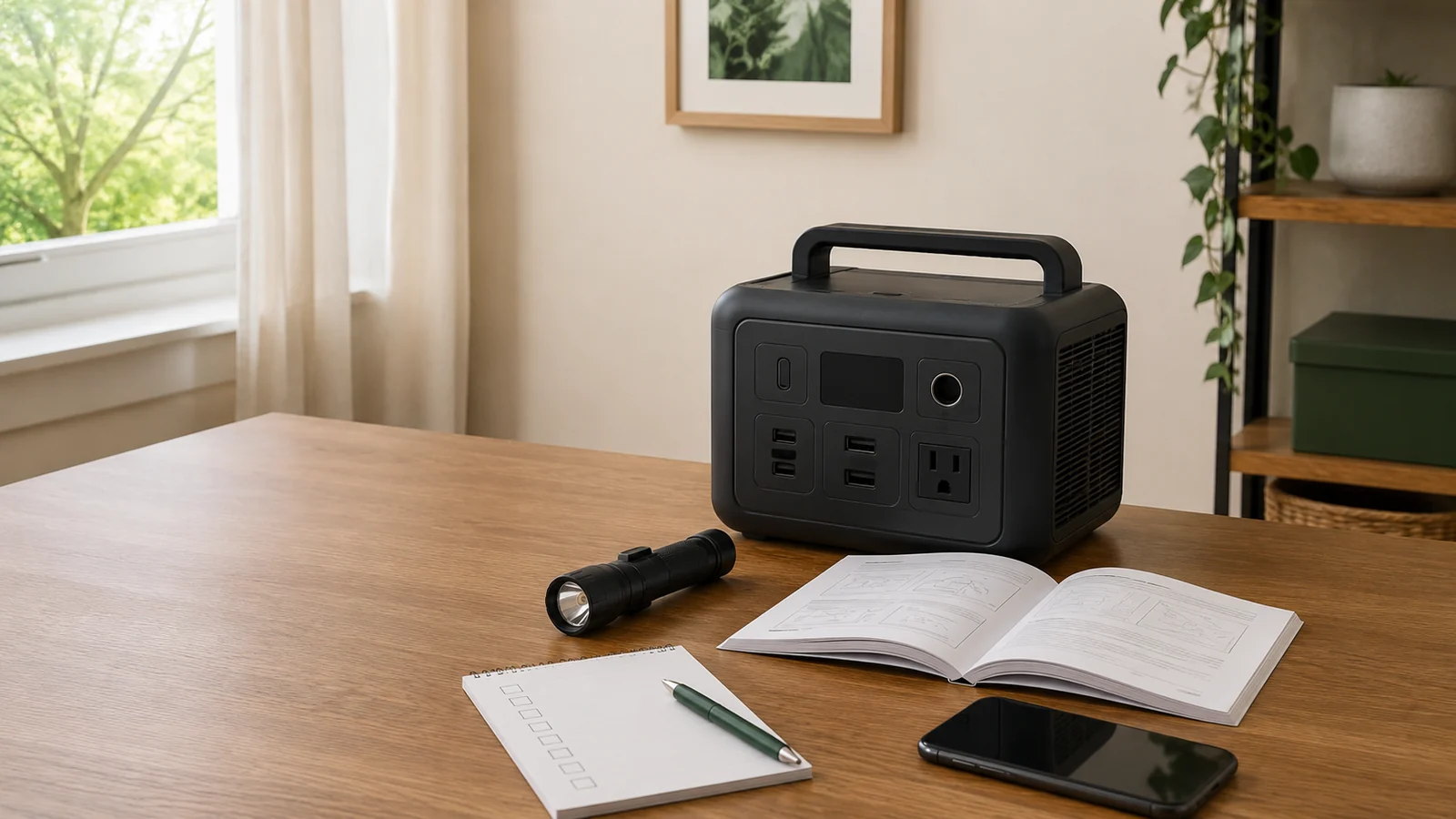
Evidence mode: Research-based + modeled
Scenario: U.S. renter, apartment dweller, or small-home household
Not included: Product recommendation, hands-on testing, wiring, or guaranteed runtime
Quick answer
Size a portable power station with two separate envelopes:
- Power envelope: the highest continuous watts that may be used at the same time, plus any exact documented startup event that may occur while other loads are already running.
- Energy envelope: the watt-hours required by the selected loads over the selected outage duration.
Do not choose a station from watt-hours alone. A battery can have enough declared energy yet still have insufficient continuous output, startup capability, per-port limits, voltage, waveform, or output-path compatibility. The reverse is also possible: a station may have adequate output power but not enough usable delivered energy for the planned duration.
Start with your own loads. For ordinary 120 V plug-in devices, the U.S. Department of Energy recommends using the exact label, EnergyGuide information, an electricity-usage monitor, or a usage calculation based on the actual product. Do not use a generic online wattage table as the final basis for a purchase.
Safety constraint: This workflow does not authorize backfeeding, premises wiring, panel work, transfer equipment, medical-device compatibility, or use of a damaged or recalled station. Keep those questions in the approved safety and professional-help routes.
What this workflow sizes
This page is for a U.S. renter, apartment dweller, or small-home household that has already:
- completed the renter backup-power readiness check;
- reviewed battery capacity and runtime claim boundaries;
- reviewed portable power station safety and indoor-use checks; and
- selected a product family and feature direction through the portable power station buying guide.
C02 owns the sizing worksheet. It does not select a model, rank products, calculate a guaranteed runtime, decide whether a motor or compressor will start, verify a solar panel, interpret a lease, or design a household electrical connection.
Before doing any arithmetic, freeze the outage scenario
A sizing result is meaningless until the scenario is defined.
Record:
- the event being planned for;
- the desired coverage period;
- whether loads must run continuously, intermittently, or only on demand;
- which people and locations the plan must support;
- whether the household can recharge during the event;
- which loads can be deferred, rotated, or dropped;
- what condition would trigger relocation instead of continued use.
Create at least two scenarios:
- Minimum continuity: only the loads required to maintain communication, safe lighting, and other approved essentials.
- Target continuity: the minimum scenario plus clearly justified convenience or resilience loads.
An optional extended scenario may be kept separately. Do not combine every possible appliance into one oversized “just in case” result.
Build the load inventory from exact evidence
For each load, record:
| Field | What to capture |
|---|---|
| Load ID | A stable name used in the worksheet |
| Quantity | Number of identical devices |
| Output path | AC, USB-C, USB-A, regulated DC, or another exact path |
| Running power | Measured or documented watts |
| Energy measurement | Measured Wh over a representative interval, when available |
| Active duration | Planned hours in the scenario |
| Duty cycle | Only when supported by measurement or an exact method |
| Startup requirement | Exact documented or measured startup watts and duration, if relevant |
| Simultaneous-use group | Which loads may operate together |
| Evidence source | Meter record, nameplate, manual, EnergyGuide, or other exact source |
| Confidence | Measured, manufacturer-declared, nameplate maximum, or unknown |
Use this source order where practical:
- a representative energy measurement for the exact device and operating mode;
- a stable power measurement for the exact device;
- an exact current manual or specification;
- an EnergyGuide or official product database entry;
- the appliance nameplate;
- a generic estimate only for early screening.
DOE notes that nameplate wattage may be a maximum and that actual consumption can vary by setting. It also notes that plug-in usage monitors can measure ordinary 120 V devices, but not large 240 V appliances. Whole-house monitors may require installation at the breaker panel and can require an electrician.
Do not open a panel, use exposed conductors, or improvise a measurement setup for this worksheet.
Use energy measurements for cycling and fluctuating loads
A device that cycles or changes power cannot be represented accurately by multiplying its highest observed watts by every hour.
The DOE standby-power measurement summary states that stable power may be read directly, while fluctuating power should be measured as energy over time and divided by the measurement interval to obtain an average. That principle is useful for refrigerators, pumps, fans with variable modes, networking equipment, and other loads whose demand changes.
For a cycling load, prefer:
measured energy over representative interval = Wh
Then scale only when the operating conditions are comparable:
scenario energy = measured interval energy × scenario duration / measured duration
Record the measurement duration, settings, ambient conditions, cycle state, and meter limitations. A six-hour measurement is not automatically representative of a hotter day, a different refrigerator temperature, or a different usage pattern.
Calculate delivered energy at the loads
For a stable or deliberately averaged load:
load energy (Wh)
= quantity × running watts × active hours × duty-cycle fraction
For a direct energy measurement, use the measured Wh instead of rebuilding it from watts and hours.
Then sum the selected loads:
required delivered load energy (Wh)
= sum of each load's scenario energy
This is the energy the loads need at their chosen outputs. It is not yet the portable power station’s required nameplate capacity.
Keep standby and station overhead separate. Add them only when they come from a product-specific measurement or defensible source. Do not hide unknown overhead inside a universal efficiency percentage.
Calculate the continuous power envelope
The station’s continuous output must cover the loads that may operate at the same time.
For each simultaneous-use group:
group running power (W)
= sum of quantity × running watts for every load in the group
The required continuous-power envelope is the largest group total.
Do not sum devices that the plan explicitly rotates. Do sum devices that may overlap in normal use, including loads that cycle automatically while another load is operating.
Also verify:
- the limit for the exact output path;
- per-port and grouped-port limits;
- total combined output;
- voltage and frequency;
- waveform requirements where relevant;
- bypass, EPS, or UPS-mode limits;
- temperature or state-of-charge derating stated by the exact manufacturer.
A station’s total headline wattage does not override a smaller port or mode limit.
Calculate startup events without a generic multiplier
Some loads have a documented startup, inrush, locked-rotor, compressor-start, or peak requirement. Treat that as a separate event.
For each possible startup event, model one starting load at a time:
startup event envelope (W)
= running watts of loads already on
+ exact total startup watts of the starting load
Here, startup watts means the starting load’s total input during the event, not extra watts added on top of that load’s running watts. Record the exact event duration as a separate requirement. If two starting loads could begin together, treat that overlap as unresolved unless a separate event-level measurement or more detailed time model supports it.
Use the largest event that can actually occur in the scenario, and keep the governing watts and duration paired.
Do not apply a universal “two times,” “three times,” or “five times” multiplier. Use an exact appliance manual, manufacturer support record, or suitable measurement. If the startup value, duration, waveform requirement, or station behavior is missing, record compatibility as unknown.
A station’s surge rating also needs exact duration and mode context. Matching one peak number to another does not prove that a compressor, pump, medical device, or motor will start and continue safely.
Translate delivered energy into a nameplate-capacity range
The exact station’s rated Wh value is a manufacturer-declared quantity. Usable delivered energy depends on system limits, output path, conversion losses, standby draw, temperature, battery condition, and test boundaries.
When product-specific assumptions are available, the method uses:
required nameplate energy (Wh)
= (required delivered load energy + documented station overhead)
  × (1 + chosen reserve fraction)
  ÷ (usable-energy fraction × output-path efficiency)
For a range, first define the same visible basis used by both bounds:
basis
= (required delivered load energy + documented station overhead)
  × (1 + chosen reserve fraction)

optimistic bound
= basis ÷ (upper usable fraction × upper efficiency)

conservative bound
= basis ÷ (lower usable fraction × lower efficiency)
Every factor must be visible.
- Usable-energy fraction: product-specific measured or appropriately bounded evidence.
- Output-path efficiency: product-specific and path-specific; AC, USB, and DC may differ.
- Station overhead: product-specific measured or documented energy.
- Reserve: a user-selected planning margin, not a scientific constant.
There is no approved universal efficiency multiplier in this project. If the required factors are unknown, the correct output is:
nameplate capacity conclusion: not yet supportable
A reserve does not repair missing evidence.
Worked synthetic example
This example demonstrates arithmetic only. It does not describe a real household or recommend a product.
Scenario loads
| Synthetic load | Evidence type | Scenario energy |
|---|---|---|
| Communications device: 22 W for 8 h | stable hypothetical input | 176 Wh |
| Two lights: 8 W each for 5 h | stable hypothetical input | 80 Wh |
| Small fan: 35 W for 4 h | stable hypothetical input | 140 Wh |
| Cycling load measured over the scenario | hypothetical direct measurement | 310 Wh |
| Required delivered load energy | 706 Wh |
The largest simultaneous running group is:
22 W + 16 W + 35 W + 120 W = 193 W
The hypothetical cycling load has a documented total startup input of 650 W lasting 2 seconds. If the other 73 W of loads may already be on:
startup envelope = 73 W + 650 W = 723 W for 2 seconds
For demonstration only, assume:
usable-energy fraction: 0.85 to 0.92
AC path efficiency: 0.82 to 0.90
reserve: 10%
documented station overhead: 0 Wh
The method produces:
optimistic nameplate bound ≈ 938 Wh
conservative nameplate bound ≈ 1,114 Wh
Rounded to avoid false precision:
illustrative range: about 940 to 1,120 Wh
continuous envelope: at least 193 W
startup event to verify: 723 W for 2 seconds, with exact load and station behavior
Changing the assumptions changes the result. The example does not establish that a real 1,000 Wh or 1,200 Wh product will deliver the required runtime or start the load.
Use three decision outputs, not one number
A completed worksheet should produce:
1. Continuous-power requirement
required continuous output: ___ W
2. Startup-event requirement
largest documented startup event: ___ W for ___
missing startup evidence: yes / no
3. Energy requirement
required delivered load energy: ___ Wh
nameplate range under stated assumptions: ___ to ___ Wh
unsupported assumptions or unknowns: ___
A product remains unsuitable when any one of these envelopes fails.
Reduce the requirement before buying a larger station
Revisit the scenario when the result is physically, financially, or operationally impractical.
Possible reductions include:
- shortening the supported duration;
- rotating loads instead of running them simultaneously;
- removing high-power convenience loads;
- using lower-power lighting or communications equipment;
- measuring a cycling load rather than using its maximum nameplate watts for every hour;
- using a no-purchase or relocation plan for unsafe indoor temperatures;
- separating high-consequence medical-device continuity from the general household plan.
Do not reduce a safety-critical requirement merely to make a product fit.
Stop conditions
Stop the sizing process when:
- the essential-load list is not agreed;
- an exact load cannot be identified;
- a cycling load has no representative energy basis;
- a startup value is material but unknown;
- the output path, voltage, waveform, or port limit is unresolved;
- a station’s usable-energy or efficiency assumption is being guessed;
- the plan depends on backfeeding, premises wiring, transfer equipment, or an improvised connection;
- a medical device is being treated as compatible based on generic wattage;
- the station or load is wet, damaged, recalled, overheating, or otherwise outside the safety gate;
- building permission or safe placement remains unresolved.
The CPSC warns that male-to-male cords and residential backfeeding can create electrocution and fire hazards. This article provides no premises-wiring route.
The FDA advises people who depend on powered medical devices to follow the device instructions and contact the manufacturer or distributor and appropriate emergency contacts. A generic household sizing worksheet cannot verify medical-device compatibility or continuity.
Sizing worksheet
Use one row per operating mode when a device has materially different settings.
| Load ID | Quantity | Output path | Data source | Running W or measured Wh | Hours | Duty cycle | Scenario Wh | Startup W/duration | Simultaneous group | Confidence / unknowns |
|---|---|---|---|---|---|---|---|---|---|---|
Scenario totals:
required delivered load energy: ______ Wh
largest simultaneous running group: ______ W
largest documented startup event: ______ W for ______
usable-energy fraction: ______ to ______
output-path efficiency: ______ to ______
documented station overhead: ______ Wh
chosen reserve: ______
resulting nameplate range: ______ to ______ Wh
unresolved blockers: ______
What remains unknown
This guide does not establish:
- the correct loads for every household;
- the energy use of an unmeasured or unidentified appliance;
- a generic startup multiplier;
- the usable AC energy of any untested station;
- a universal inverter efficiency;
- a guaranteed runtime;
- whether a specific appliance will start;
- medical-device compatibility;
- solar-panel compatibility;
- premises-wiring or transfer-equipment suitability;
- legal or building permission;
- the best product, price, warranty, or affiliate option.
These unknowns are deliberate boundaries, not invitations to fill gaps with optimistic assumptions.
Related decision handoffs
- Renter readiness decides whether entering the category is feasible.
- Capacity and runtime claims explains W, Wh, usable energy, surge, efficiency, and cycle claims.
- Portable power station safety owns recall, condition, placement, charging, and backfeeding boundaries.
- Portable power station buying guide owns product-family and feature fit.
- The future runtime calculator will own interactive runtime recomputation only after a separate method, fixtures, tools-hub, and publication gate pass.
- The future alternatives page will compare battery stations and fuel generators under a common scenario after its evidence gate passes.
Method and sources
The versioned method behind this page is stored as c02-sizing-method-v001. It separates load-side delivered energy, simultaneous running power, startup events, and nameplate conversion assumptions. Synthetic fixtures test arithmetic, ranges, missing-input behavior, and invalid values.
Primary sources checked July 21, 2026; source access and cited passages rechecked September 11, 2026. The original DOE Energy Saver page is unavailable; its February 8, 2025 print capture is linked below through a BPI-hosted PDF.
- U.S. Department of Energy: Estimating Appliance and Home Electronic Energy Use (archived page; BPI-hosted PDF)
- U.S. Department of Energy/FEMP: Measuring Standby Power
- NIST: Watt definition
- PHMSA: Interpretation 25-0021 on nominal energy/Wh rating
- DOE/FEMP and NREL: Battery Energy Storage System Evaluation Method
- NREL: Performance and Health Test Procedure for Grid Energy Storage Systems
- CPSC: Male-to-male extension-cord and backfeeding warning
- FDA: Medical devices and natural disasters
- U.S. Fire Administration: Battery Fire Safety
Recheck every material source and the exact method revision before public deployment or any later indexable release.
Related reading: Portable Power Station vs Gas Generator for Home Backup