
Evidence summary
This is a documentation-based comparison checked on October 17, 2026. It uses current official manufacturer support, store, privacy and policy pages, plus a U.S. regulator recall record and a federal consumer-IoT framework. No Sense or Emporia hardware was purchased, installed or tested. No electrical panel was opened. No household measurements, independent calibration runs, network-recovery tests, security assessments or billing disputes were evaluated.
The comparison is intentionally asymmetric. Sense says it permanently ended direct sales of panel-installed home monitors by December 31, 2025, or earlier if inventory ran out, while continuing support for existing monitors and shifting new access toward eligible utility smart meters. Emporia currently lists Vue 3 configurations in its official U.S. store. A fair decision therefore starts with buyer state—existing Sense owner, eligible Sense-meter household, or new hardware buyer—rather than forcing both names into a conventional current-product ranking.
A current U.S. comparison for households deciding between an existing or utility-enabled Sense route and currently sold Emporia monitoring hardware.
Quick answer
There is no universal winner. For an existing Sense owner with a working monitor, adequate data and acceptable ongoing account/cloud dependencies, keeping the installed system may be the lowest-friction choice. For a household whose utility and address are eligible for Sense through a compatible smart meter, the meter route may provide a no-panel-access path, but it is a separate account and data path rather than a seamless hardware replacement. For a new buyer who needs currently sold panel hardware and selected-circuit sensors, Emporia is the current documented candidate after architecture, permission, compatibility, recall, network, privacy and qualified-installation gates pass.
Do not buy either route when a utility portal, temporary plug-level measurement or the existing setup already answers the decision. Do not use either consumer system as billing-grade evidence. If the household requires local-only operation, rejects vendor accounts or cloud processing, cannot establish panel permission, or has an unresolved electrical condition, neither documented route is ready.
Start with your buyer state, not the brand names
Scroll horizontally to see all columns.
| Buyer state | Sense route | Emporia route | Evidence-safe next step |
|---|---|---|---|
| Existing Sense panel-monitor owner | Current support, app access, detection and updates are manufacturer-stated to continue | Possible replacement or selected-circuit expansion candidate | Keep the existing monitor unless a defined unmet need justifies changing systems |
| Household eligible for Sense through its utility meter | Utility- and address-specific meter route | Utility Connect may also be relevant only where the exact meter and utility are supported | Verify the household’s exact eligibility and data path before comparing features |
| New buyer needing current panel hardware | Direct panel-monitor sales ended; reseller or secondhand acquisition is a legacy route | Current Vue 3 configurations were listed on October 17, 2026 | Evaluate Emporia only after the monitor-architecture and installation-safety gates pass |
| Renter or household unable to modify the panel | Eligible Sense-enabled meter may avoid panel hardware | Eligible Utility Connect may avoid panel hardware | Prefer utility data or an eligible meter-linked route; otherwise keep existing/no purchase |
| Household requiring local-only operation | Documented account/network/vendor route does not fit | Documented cloud/app route does not fit | Neither candidate |
Takeaway: “Sense versus Emporia” is not one question. It is at least three different acquisition and continuity decisions.
What the two architectures actually do
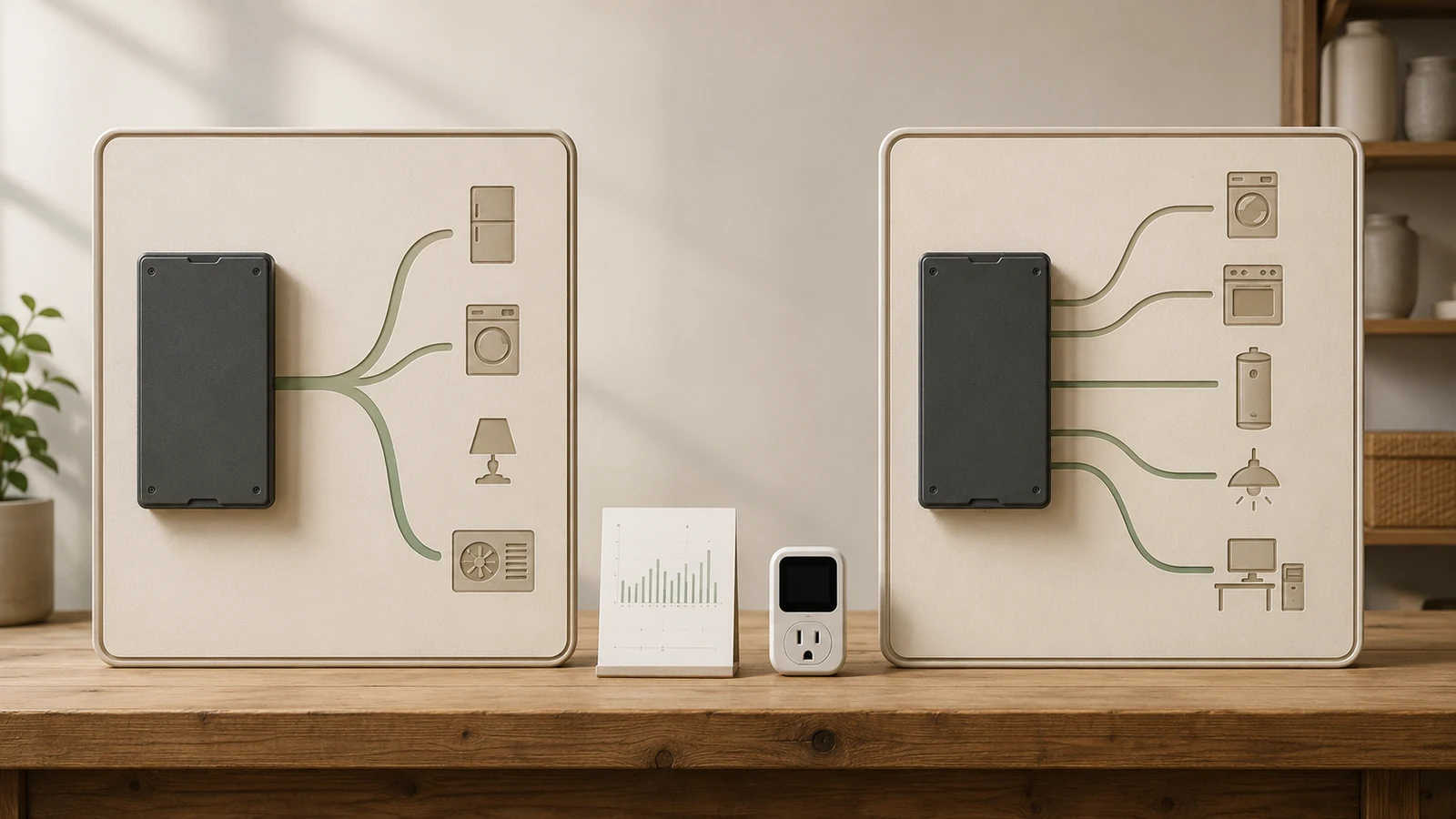
Sense and Emporia are often discussed as if they produce equivalent evidence. They do not. A legacy Sense panel monitor observes aggregate electrical signatures and uses software inference to identify devices over time. Sense explains that device detection is a learning process; the documentation does not establish that every appliance will be identified in every home. Eligible installed Sense monitors can add bounded dedicated-circuit monitoring for up to two circuits when the auxiliary port is available, but that feature is not available through a Sense-enabled utility meter.
Emporia Vue measures aggregate mains and can add sensors to selected branch circuits. Emporia documents support for up to sixteen branch circuits per Vue, with multiple-device configurations for larger or multi-panel situations. Selected-circuit measurement is not the same as appliance-level identification on a shared circuit: a sensor can attribute the circuit total without proving which appliance produced each change.
Scroll horizontally to see all columns.
| Dimension | Sense | Emporia Vue | What the evidence does not prove |
|---|---|---|---|
| Primary panel view | Aggregate waveform plus inferred device signatures | Aggregate mains measurement | That either view explains every load |
| Direct circuit measurement | Up to two dedicated circuits for an eligible installed monitor | Up to sixteen selected circuits per Vue; multiple Vues may extend coverage | That every shared-circuit appliance is separately identified |
| New no-panel route | Sense-enabled utility meter for eligible households | Utility Connect for supported utilities/meters | Universal utility or address eligibility |
| Device attribution | Software inference plus bounded dedicated-circuit option | Direct selected-circuit totals; additional connected-device integrations may add context | A matched device-detection winner |
| Billing authority | None established | Emporia states Vue is not revenue grade | Permission to override a utility record |
Takeaway: Inferred devices, circuit totals and utility-meter readings are different evidence.
Current acquisition is not symmetric
Sense’s transition changes what “buying Sense” means. The company states that direct sales of its panel-installed consumer monitor ended permanently. Existing owners can continue using supported hardware, and some households can access Sense through participating utility smart meters. A secondhand or reseller monitor is a separate legacy-acquisition decision involving hardware condition, a complete accessory set, factory reset, seller legitimacy, warranty, panel compatibility and qualified removal or installation.
The Sense transition FAQ contains a material reseller-warranty conflict. One answer says reseller products will not have a warranty, while later wording says new purchases from a licensed reseller receive the standard one-year warranty. That conflict is not resolved by choosing the more favorable sentence. A prospective reseller buyer should obtain exact written terms for the seller, product condition, proof of purchase and date before treating warranty as known.
Emporia’s dated U.S. acquisition inputs remain incomplete ownership-cost inputs. Checked October 17, 2026, its official Vue FAQ lists mains-only at USD 99.99, mains plus eight branch sensors at USD 149.99, and mains plus sixteen branch sensors at USD 199.99; the selected sixteen-sensor product listing agrees. The current generic Utility Connect product and energy-monitor collection both show USD 39.99. This current generic listing does not verify the earlier SaveOnEnergy offer or retrospectively settle its historical price. Tax, shipping, extra sensors, panel work, qualified labor, network changes and future service costs remain separate or unknown.
Scroll horizontally to see all columns.
| Route | Observed acquisition state | Dated price evidence | Mandatory limitation |
|---|---|---|---|
| Sense existing monitor | Supported existing-owner route | Not a new purchase | Support continuation is a current statement, not a guaranteed horizon |
| Sense-enabled meter | Utility/address eligibility required | Sense states no app subscription | No subscription does not mean no utility, account, network or support dependency |
| Sense reseller/secondhand monitor | Legacy acquisition hold | No approved current price in this analysis | Unknown is not zero; historical MSRP is not current price |
| Emporia Vue 3 monitor only | Official-store observation | USD 99.99 on October 17, 2026 (official Vue FAQ) | Not checkout total or installed cost |
| Emporia Vue 3 plus eight sensors | Official-store observation | USD 149.99 on October 17, 2026 (official Vue FAQ) | Exact panel fit and labor not established |
| Emporia Vue 3 plus sixteen sensors | Official-store observation | USD 199.99 on October 17, 2026 (official Vue FAQ) | Does not guarantee all-circuit coverage |
| Emporia Utility Connect | Current generic product and collection agree; exact utility/meter eligibility remains required | USD 39.99, checked October 17, 2026 | Does not verify the historical SaveOnEnergy offer or work with every utility or meter |
Takeaway: Use the dated configuration and seller; a hardware price is not an installed or lifetime cost.
When keeping an existing Sense monitor is rational
Replacing a working system creates switching cost, account changes, installation work and new uncertainty. Sense says existing monitor customers will continue to receive support, firmware, app access, device detection and security updates. That makes “keep existing” a legitimate decision when the monitor still answers the household’s question and the owner accepts the current vendor-service dependency.
Keep-existing becomes weaker when the household needs directly selected measurements for more than two circuits, requires a data resolution or export route not established for Sense in this comparison, cannot accept unresolved integration longevity, or has failing hardware. A failed installed monitor should not be treated as a simple shopping comparison; support, safe removal and any replacement require a qualified route.
Scroll horizontally to see all columns.
| Existing-owner condition | Default disposition | Why |
|---|---|---|
| Working monitor; existing data answers the decision | Keep existing | A new purchase may add cost and dependencies without changing action |
| Needs one or two eligible dedicated circuits; auxiliary port free | Bounded Sense dedicated-circuit candidate | Up to two circuits for eligible installed monitors; a free port does not prove sensors are already installed, and new panel work still requires permission and qualified review |
| Needs three to sixteen directly selected circuits | Evaluate current Emporia architecture after hard gates | The documented Sense bounded circuit route does not cover that count |
| Needs more than sixteen directly selected circuits | Hold for exact multiple-Vue configuration review | A single Vue is not established to cover this count; Combined/Nesting rules must prevent double counting |
| Monitor works but has unresolved data/support gap | Hold | Do not replace or retain blindly until the gap is defined |
| Monitor failed or appears damaged | Stop and use support/qualified review | Installed-panel equipment is not a casual swap |
| Moving to a Sense-enabled meter | Treat as a separate account/data route | Sense says monitor data cannot currently migrate to the meter account |
Takeaway: Keep a working system when it answers the need; expansion or replacement keeps its own hard gates.
Data resolution, retention and export
A “real-time” label is not enough. The buyer should define the shortest interval needed, the retention window needed, whether export matters, and what happens during an internet outage. In this packet, Sense documents hour and day CSV downloads through the Sense Home app. That does not prove the same high-resolution retention/export route documented by Emporia.
Emporia documents one-second data retained for three hours, one-minute data for seven days, fifteen-minute data for one year, and hourly/daily/aggregated data for the lifetime of the device. Its CSV export documentation describes second, minute, fifteen-minute, hourly and daily files. These are current vendor statements, not a promise that the policy or service will never change.
The current Vue 3 product specifications list Wi-Fi and Ethernet, while generic support pages emphasize 2.4 GHz Wi-Fi. Verify the exact model and connection route; neither description establishes local-only operation.
Scroll horizontally to see all columns.
| Question | Sense evidence in scope | Emporia evidence in scope | Decision rule |
|---|---|---|---|
| Hour/day export | Documented | Documented | Either may remain viable if that resolution is enough |
| Minute/second export | Not established by the Sense sources checked for this comparison | Documented with retention windows | Hold Sense for this need; verify exact Emporia workflow |
| Long-term high-resolution history | Not established here | High-resolution detail ages into coarser retained data | Plan exports rather than assuming indefinite detail |
| Offline operation | Not established as local-only | Short buffering and changed longer-outage behavior documented | Neither is a strict local-only route |
| Account migration | Monitor-to-meter data migration unavailable | Not applicable to that Sense transition | Include account/data discontinuity in switching cost |
Takeaway: Match interval, retention and export together; a real-time label does not establish retained detail.
Accuracy and attribution: do not rank unlike claims
Emporia publishes conditional accuracy language and says Vue is not revenue grade. Its export guidance describes a typical plus or minus two percent comparison with utility usage for the same period. Its current CT accuracy page limits the discussed sensor results to standard rigid Vue 3 mains and branch current transformers (CTs), excluding flexible Rogowski sensors. Configuration, load, power factor, timing and sensor scope matter; this is manufacturer evidence, not independent calibration for the buyer’s panel.
Sense’s central differentiator in the evidence checked for this comparison is software inference: it attempts to learn device signatures from aggregate measurements. That is not the same metric as a current-transformer percentage under Emporia’s conditions. Comparing the two as “which is more accurate?” without a common reference instrument, matched loads, sampling interval, panel configuration, uncertainty method and attribution definition would be false precision.
Scroll horizontally to see all columns.
| Claim type | Sense | Emporia | Allowed conclusion |
|---|---|---|---|
| Whole-home energy measurement | Consumer insight route | Conditional manufacturer accuracy language; not revenue grade | No billing authority for either |
| Device identification | Machine-learning inference; incomplete detection possible | Selected-circuit totals, not universal appliance separation | Different attribution architectures |
| Independent matched test | Not performed | Not performed | No accuracy or reliability winner |
| Household savings outcome | Not measured | Not measured | No savings percentage or payback claim |
Takeaway: No matched independent comparison or billing authority is established.
Account, cloud, privacy and security review
Both routes should be evaluated as connected-product ecosystems: device or meter, app, account, network, cloud, updates, support and third-party integrations. Sense’s privacy policy describes account, home, device, energy and utility-linked information. Emporia’s policy describes identity, device, power, inferred and integration information. Read the current policy for the exact account route, not just the package box.
Sense also publishes security statements, and Emporia documents cloud behavior, but manufacturer descriptions are not an independent comparative security audit. This article does not declare a privacy or security winner. A household that rejects the relevant data-processing route should choose neither documented candidate rather than using a high feature count to override that boundary.
Scroll horizontally to see all columns.
| Check | Why it matters | Fail-closed outcome |
|---|---|---|
| Exact account owner and household access | Energy patterns may reveal occupancy and appliance behavior | Hold until roles and sharing are understood |
| Cloud and internet dependence | Remote history and processing can depend on vendor services | Neither if local-only operation is mandatory |
| Retention and deletion | High-resolution detail and deletion behavior differ | Hold if the policy conflicts with household requirements |
| Export route | Needed for independent analysis or long-term records | Choose only a route that supports the required interval |
| Integration partners | Third-party compatibility and data flow can change | Do not rely on an unverified integration |
| Support horizon | Connected features depend on ongoing service | Keep existing/no purchase if the dependency is unacceptable |
Takeaway: A feature list cannot override an unacceptable or incomplete account and data-processing review.
Installation, permission and recall boundaries
This comparison provides no electrical installation instructions. Sense directs panel-monitor installation to an electrician or qualified professional. Emporia’s current installation guidance describes situations in which owners may self-install, but also notes local-code, rental, insurance, comfort and unusual-panel reasons for qualified help. For this renter/small-home publication, unknown panel identity, permission, service configuration, conductor fit, available space, sensor placement or installation responsibility is a stop or professional-review condition.
Recall treatment must be exact. The CPSC Emporia record concerns specified North America smart plugs, not Vue panel monitors. A brand-level recall statement would be false. Check the exact model/family before release and before use, and follow the regulator’s remedy if an exact product is affected.
Scroll horizontally to see all columns.
| Unresolved condition | Required response |
|---|---|
| Damage, heat, sparking or abnormal condition | Stop; do not use or install |
| Exact affected recall | Stop and follow the regulator/manufacturer remedy |
| Permission denied or unknown | No panel hardware; use an eligible no-panel route or no purchase |
| Panel/service/sensor fit unknown | Qualified panel-specific review |
| Qualified installation responsibility unresolved | Professional review required |
| Billing dispute | Use the utility bill, utility process or approved revenue meter |
Takeaway: Unresolved permission, equipment or qualified responsibility needs a separate review route.
A non-scoring decision workflow
- Define the question. Whole-home timing, inferred appliance patterns, directly selected circuits, meter-linked visibility, billing evidence or another need are not interchangeable.
- Complete the architecture gate. Use the home energy monitor buying guide to decide whether utility data, plug measurement, aggregate mains, selected circuits or a hybrid route is necessary before choosing a vendor.
- Identify buyer state. Existing Sense owner, eligible Sense-meter user, new current-hardware buyer or legacy Sense acquirer.
- Apply safety and permission stops. Use the installation safety and permission checklist. Damage, recall, panel access, exact compatibility and qualified responsibility come before features.
- Apply account and privacy gates. Reject both if local-only operation is mandatory or the household does not accept the documented cloud/account route.
- Match attribution architecture. Inferred devices, one-to-two dedicated circuits and up-to-sixteen selected circuits solve different problems.
- Match data requirements. Record the required interval, retention and export workflow.
- Use dated costs only after hard gates. Unknown Sense legacy acquisition cost stays unknown. Emporia store observations do not become installed or lifecycle costs.
- Choose among keep existing, candidate, hold, professional review, neither or no purchase. A feature total never rescues a failed hard gate.
Scroll horizontally to see all columns.
| Outcome | Meaning | What it does not mean |
|---|---|---|
| Keep existing Sense | A working supported monitor still answers the defined question | Guaranteed lifetime support |
| Sense meter candidate | Exact utility/address/meter eligibility passed | Feature or history parity with panel monitor |
| Emporia current candidate | Current hardware remains after architecture, safety, account and price gates | Recommendation or installation approval |
| Legacy Sense acquisition hold | Reset, condition, seller, warranty, accessories or compatibility unresolved | Automatic rejection or endorsement |
| Professional review | Panel, permission or installation responsibility unresolved | Legal or code interpretation by this article |
| Neither | A hard requirement conflicts with both documented routes | Claim that no other market option exists |
| No purchase | Existing/utility data already supports the decision | Failure to make a decision |
Takeaway: A candidate is a bounded route for further checks, without a score, winner or installation approval.
What remains unknown or unverified
- No current manufacturer-direct Sense panel-monitor price exists in this comparison after direct sales ended.
- No reseller or secondhand Sense unit, seller, accessory set, reset state, warranty or physical condition was checked.
- No household’s Sense-meter or Emporia Utility Connect eligibility was checked.
- No exact panel, service, conductor, circuit count, available space, lease permission or qualified-installation quote was reviewed.
- No independent matched accuracy, device-attribution, latency, offline-recovery, reliability, privacy, security or support test was performed.
- No complete checkout total, installed cost, subscription-equivalent dependency cost, replacement schedule or lifecycle cost was calculated.
- No household energy-saving percentage, payback period or bill reduction was established.
- No unverified integration or apartment-audit handoff is used. Required data limits are stated here; a linked guide does not establish exact household or panel fit.
Bottom line
Keep a working Sense monitor when it still answers the household’s question and its current support/account assumptions are acceptable. Consider Sense through a utility meter only after exact household eligibility is confirmed, and treat it as a separate account/data route. For a new buyer who needs currently sold panel hardware or more directly selected circuits, Emporia is the current documented candidate only after architecture, permission, compatibility, recall, network, privacy and qualified-installation gates pass. Choose neither—or no purchase—when the hard requirements do not fit. The right result is the narrowest route that changes a real decision, not the brand with the longest feature list.
Related reading
Start with the home energy monitor buying guide to choose the measurement architecture. Use the installation safety and permission checklist for the property, equipment and qualified-review boundaries.
For the separate export and integration decision, read Home Energy Data, App, and Smart-Home Integrations Compared. It distinguishes documented data routes and account boundaries without treating an integration listing as proof of compatibility, privacy, reliability or savings.
Method and update obligations
For a meter-linked comparison, Sense-enabled meter eligibility and Emporia Utility Connect eligibility are separate checks. For Utility Connect, verify the exact utility, address, meter and Zigbee/HAN route, then account/privacy acceptance, network, data/export fit, the exact product and dated acquisition input. A supported meter route does not establish directly selected-circuit or inferred-appliance attribution.
This comparison uses a deterministic, non-scoring method. Known hazards or an exact affected recall stop the comparison; unknown safety or recall context remains on hold. Billing-grade requests route to the utility process rather than creating consumer-monitor authority. The method then checks architecture, affirmative account/privacy acceptance, actual interval/retention/export fit, buyer state, exact measurement scope and support dependence. New or expanded panel hardware must pass the same permission, qualified-installation, compatibility, recall and dated-price gates. Existing DCM is distinguished from new panel work; meter eligibility never proves direct selected-circuit fit. It never returns a score, universal winner, product recommendation or installation or billing authority. Synthetic software checks are not hardware tests or household evidence.
Recheck the decision when Sense changes monitor support, meter eligibility, account migration, warranty or integrations; Emporia changes products, prices, retention, export, cloud behavior, privacy, warranty or installation guidance; CPSC issues a relevant recall; either vendor changes support/update terms; the parent architecture or installation-safety guidance changes; or a current independent matched test becomes available. Product, app, price, privacy and recall triggers override a routine calendar.
Method and sources
The linked sources support dated manufacturer observations, exact regulator scope and a connected-product question framework. They do not establish household eligibility, independent accuracy, comparative security, installation approval or savings. Source and method checks were updated October 17, 2026.
- Sense support transition FAQ
- Sense home compatibility
- Sense installation boundary
- Sense compatible panel configurations
- Sense device-detection method
- Sense data download
- Sense no-subscription statement
- Sense hardware warranty
- Sense dedicated-circuit monitoring
- Sense meter setup failure/eligibility
- Sense setup-path distinction
- Sense privacy policy
- Sense security statement
- Sense smart-plug integration
- Sense legal/warnings/specifications
- Emporia energy-monitor collection
- Emporia Vue 3 product page
- How the Emporia Vue works
- Emporia CT accuracy
- Emporia data storage
- Emporia export
- Emporia offline behavior
- Emporia privacy policy
- Emporia Vue installation decision
- Emporia combined Vues
- Emporia Utility Connect product
- Emporia Utility Connect overview
- CPSC Emporia smart-plug recall
- NIST IR 8425 consumer IoT profile
- Emporia Vue official FAQ
What changed
- October 16, 2026 — Refreshed current configuration prices, the Utility Connect product route and Sense app export wording; retained historical uncertainty.
- October 16, 2026 — Clarified standard rigid CT accuracy scope and tightened the comparison’s privacy, data-workflow, circuit-count and existing-installation boundaries.
- October 17, 2026 — Refreshed the dated acquisition and critical-source checks, and clarified separate Sense-meter and Utility Connect eligibility, measurement and data-review boundaries. No product, household or installation test was performed.