
Evidence summary
This guide was initially sourced on July 27, 2026. Official routes and their limited scope were reviewed on October 15, 2026. That routing review does not refresh the dated manufacturer price observations or establish current offers, exact product labels, stock, dose, yield, safety-data-sheet identity or lot-specific recall clearance. It is research-based. No cleaner was purchased, mixed, diluted, applied or tested. No laboratory performance, toxicity, packaging, shipping, household-cost or lifecycle-impact measurement was performed. Historical manufacturer observations are dated and qualified. Three entries in the surviving July 27 research notes could not be corroborated against the original primary pages: the Method two-dose concentrate and the Cleancult 16 fl oz ready-to-use and 32 fl oz refill. They remain visible as uncorroborated notes only; their prices, preparation wording and availability are not admitted as manufacturer facts or comparison inputs. This evidence qualification was reviewed on October 16, 2026.
No commercial relationship is declared and there are no affiliate links. This research-based guide does not establish legal compliance, individual health suitability, product certification or a universal environmental winner.
Quick answer
Compare cleaner formats only after fixing the same task, surface and label-use boundary. Keep a suitable product already owned when it works. A ready-to-use product reduces preparation steps; a bulk refill can reuse a durable sprayer; a liquid concentrate, small dose or tablet can reduce shipped water and storage volume; a refill carton can separate the refill from the applicator. None of those facts proves lower total impact, lower cost, equal performance or greater safety.
For every candidate, record the exact product, current label, recall status, dose, prepared volume, compatible bottle or trigger, repeatable refill access, package components and local end-of-life route. Hold the decision when one of those central facts is missing. Stop for an affected recall, leaking or unlabeled container, or any plan to mix cleaners.
Fix the same cleaning task before comparing format
Format is not a substitute for product fit. The same household may reasonably use a ready-to-use spray for one task, a concentrate for another and no new purchase for a third. Start with routine, non-disinfecting cleaning of one exact manufacturer-compatible sealed hard surface. If the real need is disinfecting, use the exact EPA registration and current pesticide label instead of this format comparison. The CDC cleaning and disinfecting guidance distinguishes ordinary cleaning from disinfecting; the EPA pesticide-label framework makes the current registered-product label the use boundary.
Swipe horizontally to see all columns.
| Field | What must be fixed | Fail-closed result |
|---|---|---|
| Task | Routine soil removal, not a pathogen-reduction claim | Route disinfecting elsewhere |
| Surface | Exact material, coating or finish | Hold or reject mismatch |
| Product identity | Name, variant, size and current label | Hold |
| Use directions | Dose, dilution, application, dwell time, rinse and storage | Do not improvise |
| Performance question | Same soil, surface, dose and method | Route decisive uncertainty to direct testing |
| No purchase | Whether a suitable owned cleaner already meets the task | Keep existing |
Six format architectures and one no-purchase route
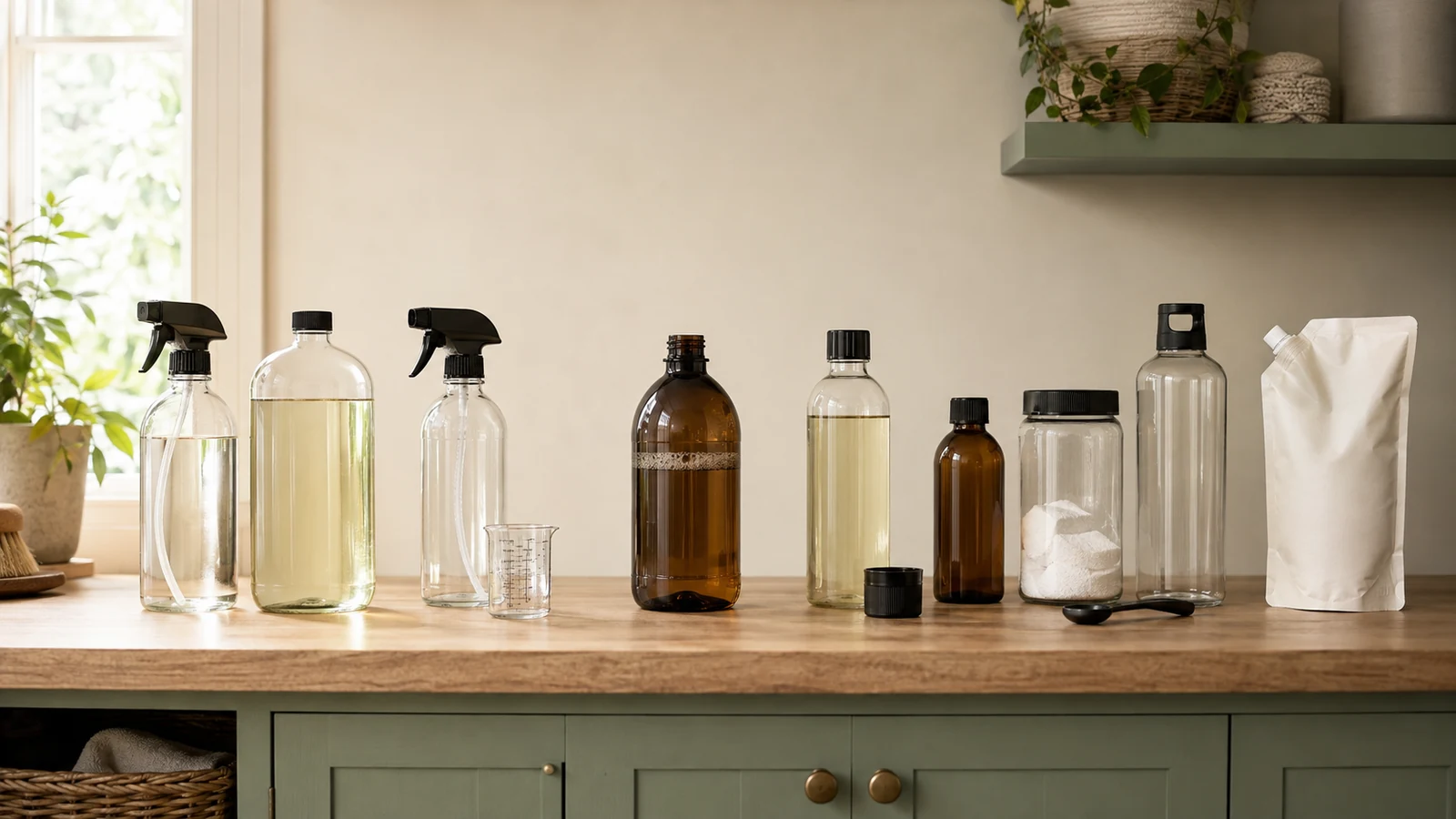
The format names below describe delivery and preparation architecture, not product quality. A complete system includes the formula, dose, water, bottle, trigger, cap, refill container, preparation label, storage and end-of-life route.
Swipe horizontally to see all columns.
| Route | Delivered state | Additional system parts | Critical unknowns |
|---|---|---|---|
| Keep existing / no purchase | Owned product | None beyond current label and safe storage | Remaining fit, recall and label condition |
| Ready-to-use | Prepared liquid | Supplied bottle and applicator | Task/surface fit, package system, repeat purchase |
| Bulk prepared refill | Prepared liquid | Transfer container plus compatible durable sprayer | Spillage, refill count, trigger compatibility, availability |
| Liquid concentrate | Concentrated liquid | Measuring route, water and prepared-use bottle | Dose accuracy, handling, prepared label and storage |
| Small concentrated refill | One or a few concentrated doses | Water and exact-size durable bottle | Yield, availability and bottle match |
| Tablet or powder refill | Dry dose | Water, dissolution route and compatible bottle | Dissolution, water quality, dose and performance |
| Refill carton or pouch | Prepared refill or concentrate | Durable bottle/trigger and sometimes added water | Yield, component scope, local end of life and access |
Check the product already in the cabinet first
Before buying a format system, consider whether a suitable cleaner already owned meets the task. The EPA waste-reduction guidance supports avoiding unnecessary purchases and reusing suitable items in general. Applying that broad guidance to an already-owned cleaner is this guide’s conditional editorial inference, not an EPA product finding or measured impact comparison. A new refill system can add a bottle, trigger, overlapping formula and storage burden before an existing suitable product is used. Keep the existing cleaner when its label is readable, the product is intact and not recalled, the task and surface match, and the remaining quantity is sufficient.
Keep-existing does not mean the product is ideal for every task. It means a new purchase has not yet demonstrated a material decision benefit.
Ready-to-use: fewer preparation steps, not an automatic winner
A ready-to-use cleaner arrives at the manufacturer-declared use concentration. That can reduce dilution error and eliminate the need to label a prepared bottle. It may also require shipping more water and buying another applicator package. The exact product label still controls surface, dose, application, ventilation, storage and food-contact instructions.
Swipe horizontally to see all columns.
| Check | Evidence | Do not infer |
|---|---|---|
| Preparation | None beyond exact label directions | Zero handling risk |
| Applicator | Supplied bottle/trigger condition and compatibility | Trigger lasts indefinitely |
| Performance | Task-matched evidence | RTU performs better than concentrate |
| Cost | Dated product price and delivered volume | Complete cost per use |
| Packaging | All components and local routes | Local recyclability |
Bulk prepared refill: reusable applicator plus transfer step
A bulk refill can replenish a compatible bottle more than once. The system is incomplete without a durable bottle and functioning trigger, exact transfer directions, storage space and a way to preserve product identity. Do not top off or combine formulas unless the current manufacturer directions explicitly establish the same exact product route; this guide provides no mixing workaround.
The official Method 68 fl oz refill page observed on July 27, 2026 stated a direct price of USD 8.99 and an approximate 2.5-bottle refill claim. The same page showed availability signals that were not fully consistent, so current availability must be rechecked rather than selected favorably. This is a dated manufacturer observation, not a live-price or lifecycle conclusion.
Liquid concentrate: dose and prepared volume are central evidence
A concentrate can reduce delivered water and storage volume, but it adds preparation, measuring, bottle and labeling requirements. Record the exact concentrate dose, water amount, final prepared volume, bottle size, applicator compatibility, prepared-product storage and any use-by direction. A fill line is a manufacturer-specific instruction, not a universal recipe.
Branch Basics’ official concentrate page was observed at USD 55 for 33.8 fl oz and uses manufacturer fill-line directions for different prepared products. This guide does not convert those directions into an independent cleaning, safety, cost or environmental verdict. The current label and safety resources remain controlling for the exact use.
The current manufacturer route does not replace an exact safety data sheet. The current safety-data-sheet document was not verified in this route review; marketing safety descriptions are not a substitute.
Swipe horizontally to see all columns.
| Input | Required record | Unknown behavior |
|---|---|---|
| Dose | Exact amount and measuring method | Hold |
| Water | Exact amount and any water-quality requirement | Hold |
| Prepared volume | Exact final volume, not just delivered concentrate volume | Hold |
| Container | Compatible bottle, trigger, material and size | Hold or incompatible |
| Prepared label | Product identity, directions and safety information | Do not create an unlabeled mixture |
| Storage | Exact manufacturer route | Hold |
Small concentrated refills: compact, but still a complete preparation system
A small concentrated dose can be easier to store than a large concentrate bottle, but the same dose, water, prepared-volume and compatible-container gates apply. Surviving research notes dated July 27, 2026 describe a Method two-dose concentrate at USD 8.99 and record a one-ounce dose with water for approximately 14 fl oz, alongside conflicting availability. The exact historical product and primary page could not be corroborated. These details describe the notes only; they do not establish manufacturer facts, product availability or usable preparation directions.
Do not use the uncorroborated preparation note to dilute any product. The exact two-dose product, its historical and current directions, prepared volume and availability remain unverified. A different current refill cannot validate the old note.
Small size alone does not prove less material, lower shipping impact or lower cost per use. The product, secondary package, durable bottle, trigger and replacement frequency remain part of the system.
Tablet and powder refills: shipped-water reduction is not performance evidence
Tablets and powders can reduce shipped water, but the actual household route includes the pack, tablet or powder dose, water, dissolution time, bottle, trigger, prepared volume and storage. Water temperature or quality requirements must come from the exact directions. Do not assume the prepared product is interchangeable with a liquid formula or suitable for every surface.
Blueland’s official two-tablet refill pack was observed at a one-time price of USD 5, with each tablet claimed to make 24 fl oz. Its starter system was observed at USD 16. Starter and refill prices must remain separate. No matched test for this guide establishes equal performance, residue, odor, surface compatibility or trigger life.
Refill cartons and pouches: count the durable bottle and the yield conflict
A carton or pouch can separate the refill from a durable applicator. That design can reduce some repeated components, but local collection and processing for the carton, cap or liner remain separate questions. The bottle and trigger do not disappear from the system.
Surviving research notes dated July 27, 2026 list a Cleancult 32 fl oz refill at USD 8.99, an equal-parts-water statement and conflicting bottle yields; they also list a Cleancult 16 fl oz ready-to-use product at USD 5.99. The original unspecified variants and primary-page observations could not be corroborated. These are uncorroborated notes, not verified historical manufacturer prices, directions or yield statements. They are excluded from preparation, cost and performance comparisons.
The former generic product URL now identifies a 32 fl oz refill, so it cannot establish the old 16 fl oz identity. Separately, the current Wild Lavender 32 fl oz page reviewed on October 15, 2026 contains conflicting two- and four-bottle wording, as described in the source limits below. That current conflict does not validate either old variant or a single yield. Do not use the uncorroborated equal-parts note as preparation instructions.
Dated format observations, not recommendations
The table preserves all nine research entries dated July 27, 2026. Three rows are explicitly uncorroborated notes, as explained beside each row; their values describe the surviving record rather than verified manufacturer facts. The remaining entries retain their original dated scope. No row is a current offer, checkout total or recommendation. The October 15 route review and October 16 evidence qualification do not refresh prices, replace variants or supply missing historical proof.
Swipe horizontally to see all columns.
| Entry and evidence status | Format recorded | Price recorded | Important limitation |
|---|---|---|---|
| Method All-Purpose Cleaner, 28 fl oz | Ready-to-use | USD 4.59 | No checkout total or performance comparison |
| Method refill, 68 fl oz | Bulk prepared refill | USD 8.99 | Approximate 2.5-refill claim; availability conflict |
| Method concentrate, 2 × 1 fl oz — uncorroborated note | Small concentrated refill, as recorded | USD 8.99 in the note; uncorroborated | Exact historical product, price, dose and availability unverified; not a preparation or comparison input |
| Blueland two-tablet refill | Tablet refill | USD 5.00 | Each tablet claimed to make 24 fl oz; no matched test |
| Blueland starter system | Bottle + tablet refill | USD 16.00 | Starter cost is not refill-only cost |
| Branch Basics concentrate, 33.8 fl oz | Liquid concentrate | USD 55.00 | Manufacturer fill-line system; no independent cost result |
| Cleancult RTU, 16 fl oz — uncorroborated note | Ready-to-use, as recorded | USD 5.99 in the note; uncorroborated | Original variant and historical price unverified; current differently identified product does not validate this entry |
| Cleancult refill, 32 fl oz — uncorroborated note | Refill carton / concentrate, as recorded | USD 8.99 in the note; uncorroborated | Original variant, price and equal-parts/yield wording unverified; no dilution direction or single yield admitted |
| Clorox Free & Clear, 32 oz | Ready-to-use | Not retained | Routine-cleaner example; no manufacturer-direct price |
Normalize cost inputs without pretending to calculate lifecycle cost
A direct price is only one dated input. A format-level cost record should separate product price, shipping, tax, durable bottle, trigger, measuring device, water, replacement components, unused-product disposal and repeat availability. This guide does not have an approved lifecycle-cost method and therefore does not calculate break-even, payback or a value winner.
Swipe horizontally to see all columns.
| Input | Record separately | Missing behavior |
|---|---|---|
| Cleaner/refill | Dated direct/list/promo type, size and condition | Unknown |
| Prepared volume | Exact dose, water and final volume | No cost-per-ounce calculation |
| Durable bottle/trigger | Initial acquisition and replacement | Unknown |
| Shipping and tax | Account/location-specific values | Unknown, not zero |
| Water and preparation | Declared amount; labor is excluded unless separately approved | Unknown |
| Unused product/end of life | Exact local route and cost when applicable | Unknown |
Compare the complete packaging system
The EPA greener-cleaning guidance treats packaging, concentration, dilution and product performance as separate considerations. The FTC environmental-claims guidance requires broad claims to be qualified. A bottle described as recyclable does not prove that the exact bottle, trigger, cap, liner, pouch or carton is collected and processed in the reader’s location.
Swipe horizontally to see all columns.
| Component | Evidence to record | Do not infer |
|---|---|---|
| Primary container | Material, size, condition and reuse instructions | Indefinite reuse |
| Trigger/applicator | Compatibility and replacement availability | Same material or local route as bottle |
| Refill package | Carton, pouch, tablet wrapper, cap or concentrate bottle | Zero packaging |
| Secondary shipping | Box, padding and delivery pattern when material | Manufacturer page is a complete shipping study |
| Prepared-use label | Identity, directions and precautions | An unlabeled mixture is acceptable |
| Local route | Collection, take-back, HHW or trash route for every material component | National universal acceptance |
Treat environmental and safety wording as separate claims
Safer Choice product status, SCIL ingredient status, fragrance-free status, DfE disinfectant status and manufacturer-created environmental wording are not interchangeable. Verify the exact current product in the relevant registry when a registered programme claim matters. Route broad “green”, “natural”, “non-toxic”, “chemical-free”, “free-of”, “less plastic” or “planet-safe” wording to the applicable trust method rather than using it as a format score.
Swipe horizontally to see all columns.
| Evidence | May support | Does not prove |
|---|---|---|
| Exact Safer Choice product row | Current product-level programme status | Universal safety or product winner |
| SCIL ingredient row | Ingredient-level programme evidence | Finished-product certification |
| Fragrance-free programme row | Exact programme scope | Allergy-safe for every person |
| DfE disinfectant row | Exact registered-product route | Off-label use or format endorsement |
| Manufacturer packaging claim | Attributed description of a component or reduction | Overall lifecycle superiority |
| Retailer or front-label badge | Discovery clue | Current official registry status |
Performance evidence must match the task
Format architecture does not establish cleaning performance. Manufacturer directions and claims can document intended use, but a matched comparison requires the same surface, soil, dose, dwell time, wiping method and observation conditions. When performance is decisive and equivalent evidence is absent, route the question to a controlled hands-on comparison. A separate controlled hands-on comparison would require physical samples and raw observations; this research-based guide has no such results and does not depend on a completed hands-on comparison.
This guide therefore never uses price, package size, programme status or concentrate ratio to rescue a candidate that fails the task, surface, label or safety gate.
Safety, recalls and disposal are exact-product questions
Follow the current product label and preserve product identity. Never mix cleaners. Stop for an affected recall, leaking container, damaged package or missing label. The CPSC recall registry must be searched with the exact product and available lot/date identifiers. Recall notices for ADIOS 30% vinegar concentrate, Fabuloso multi-purpose cleaners and Angry Orange enzyme stain removers illustrate exact product and remedy boundaries; none supports a category-wide conclusion.
Unused cleaner disposal can depend on local household-hazardous-waste programmes. The EPA household hazardous waste guidance does not create a universal drain, trash or recycling route. Keep local acceptance unknown until the exact programme and item are verified.
Swipe horizontally to see all columns.
| Condition | Result | Safe boundary |
|---|---|---|
| Affected recall | Stop | Follow exact remedy |
| Recall unknown | Hold | Identify product and recheck |
| Leaking, damaged or unlabeled container | Stop | Do not use or transfer |
| Plan to mix products | Stop | Use one exact labeled route only |
| Dose or prepared volume unknown | Hold | Obtain exact directions |
| Bottle/trigger mismatch | Reject or hold | Do not improvise applicator compatibility |
| Medical/allergy outcome requested | Qualified route | No universal health verdict |
| Local disposal route unknown | Hold | Check local programme |
Renter and small-home constraints can change the format fit
A format can fail even when its formula is suitable. Large bulk containers need storage space and safe transfer. Concentrates need measuring and labeling. Tablets need a compatible bottle and preparation time. Ready-to-use products can be easier to manage but may multiply containers. Renters may not control local waste, building storage or delivery routes. Keep the format set bounded to the household’s actual space, preparation tolerance, refill access and labeling discipline.
Swipe horizontally to see all columns.
| Constraint | Questions | Possible outcome |
|---|---|---|
| Storage | Can bulk or concentrate be stored safely and upright? | RTU, small refill or keep existing |
| Preparation space | Can dosing, filling and labeling be done without spills or mixing? | RTU or hold |
| Bottle durability | Is the exact trigger intact and replaceable? | Refill candidate or hold |
| Refill access | Is the exact refill repeatably obtainable? | Candidate, hold or incompatible |
| Local end of life | Are the exact components collected or accepted? | Local-route hold |
| Overlapping products | Does an owned cleaner already cover the task? | No purchase |
A fail-closed format workflow
- Define one routine task and exact surface. Route disinfecting elsewhere.
- Inspect the suitable product already owned. Check label, condition and recall.
- Freeze exact candidates. Record product, variant, size, current label and format.
- Verify dose and prepared volume. Do not compare delivered package size with prepared-use volume.
- Record the complete container system. Include bottle, trigger, cap, refill, measuring route and preparation label.
- Check repeatable access. A refill route is not useful when the exact refill is unavailable or contradictory.
- Separate performance evidence. Route decisive uncertainty to controlled testing.
- Route claims correctly. Registered label, non-label environmental claim and local disposal each have separate evidence paths.
- Keep unknowns visible. Do not set missing cost, yield or disposal data to zero.
- Choose a bounded outcome. Keep existing, retain one or more format candidates, route for evidence, hold, reject or stop.
Swipe horizontally to see all columns.
| Outcome | When it applies | What it does not mean |
|---|---|---|
| Keep existing / no purchase | Owned suitable product passes | Universal product winner |
| Ready-to-use candidate | Prepared product passes task, surface, label and safety gates | Safest or lowest-impact format |
| Bulk refill candidate | Prepared refill and durable applicator system pass | Zero packaging |
| Concentrate candidate | Dose, water, yield, bottle and handling pass | Automatic cost savings |
| Tablet/powder candidate | Preparation, bottle and performance evidence pass | Equal performance by format alone |
| Trust or registry route | A claim or registered label is decisive | Claim accepted before review |
| Hands-on route | Matched performance is decisive | Products have already been tested |
| Hold | Central evidence is missing or conflicting | Unknown is favorable |
| Stop | Recall, damage or mixing plan | A workaround should be invented |
What this guide could not verify
- No universal cleaner-format winner, best value, safest format or lower-impact format.
- No matched household performance, residue, odor, dose, packaging, shipping or lifecycle test.
- No live price, checkout total, cost per prepared ounce, cost per use, payback or lifecycle result.
- No current local refill, take-back, recycling or household-hazardous-waste route for an unspecified location.
- No medical, allergy, child, pet, toxicology, legal or pesticide-enforcement conclusion.
- No physical hands-on comparison result.
- No product recommendation, affiliate link or commercial CTA.
Update triggers
Reopen research when the format, formula, dose, prepared volume, refill count, durable bottle, trigger, label, safety data, recall, price, availability, packaging, programme status, local end-of-life route, related trust guidance, new hands-on evidence or a dependency requirement changes. Recheck exact manufacturer pages, recalls, Safer Choice/DfE routes and availability on the release date. Changing only the visible checked date is not a substantive update.
Bottom line
Choose format after the task—not before it. Use a suitable cleaner already owned when it works. Ready-to-use reduces preparation; refills rely on a durable applicator; concentrates and tablets require exact dosing, water, prepared volume and labeling. Compare the complete system, preserve missing information as unknown, route claims and local disposal to their proper evidence paths, and stop rather than improvise when recall, damage, mixing, label, dose or container compatibility is unresolved.
Related reading
- How to Verify Environmental Claims on Household Products
- Biodegradable vs Compostable vs Recyclable: What Each Claim Requires
- Natural and Non-Toxic Cleaning Claims: What They Do and Do Not Prove
Household cleaning-product buyer guide: compare the cleaning task, label directions and evidence before choosing a format.
Method and validation
The decision method behind this guide uses a deterministic, non-scoring, fail-closed router. It checks task, surface, exact identity, label, recall, container condition, mixing, existing-product preference, requested format, dose, prepared volume, bottle compatibility, refill access, packaging scope, local end of life, performance evidence and claim route. It can preserve no-purchase, bounded format candidates, trust routes, local-disposal routes, hands-on routes, holds, incompatibility, stops and specialist review. It cannot select a brand, award a score, name a winner or establish health, legal or certification conclusions.
The router passed 30 deterministic fixtures, rejected 12 invalid inputs and passed 800 randomized property checks. These are software tests only.
Official routes and limits of the dated observations
Official routes were reviewed on October 15, 2026. Product links identify manufacturer routes only; they do not recheck the July 27 price observations, prove availability or clear an exact current product, label, dose, ingredient record or recall. Follow the current exact product label before use. The October 16 evidence qualification withdraws the three uncorroborated entries as manufacturer evidence; their survival in our notes is not primary-source corroboration. Unresolved documents and variants remain unresolved.
- Identifying Greener Cleaning Products
- Safer Choice Standard and Criteria
- Safer Choice Products
- Safer Chemical Ingredients List
- Safer Choice Criteria for Fragrance-Free Products
- DfE-Certified Disinfectants
- Introduction to Pesticide Labels
- Household Hazardous Waste
- EPA waste-reduction guidance — Broad waste-prevention context; the keep-existing cleaner application is an editorial inference.
- When and How to Clean and Disinfect Your Home
- CDC cleaning and disinfecting with bleach
- FHSA Cautionary Labeling FAQ
- CPSC Recalls
- CPSC Compare Brands ADIOS 30% recall notice
- Fabuloso Multi-Purpose Cleaner Recall
- CPSC Thrasio Angry Orange enzyme stain-remover recall
- Environmental Claims Summary of the Green Guides
- Method All-Purpose Cleaner — Ready-to-Use 28 fl oz
- Method All-Purpose Cleaner Refill — 68 fl oz
- Method two-dose concentrate: historical and current identity unresolved — The July 27 entry is retained only as an uncorroborated research note. No verified manufacturer price, preparation direction or replacement product is admitted.
- Multi-Surface Cleaner Refill Tablets
- Blueland multi-surface starter system
- The Concentrate — 33.8 fl oz
- Cleancult current 32 fl oz refill discovery route — This current 32 fl oz discovery route does not corroborate the July 27 unspecified 16 fl oz entry, which is retained only as an uncorroborated note.
- Cleancult Wild Lavender refill: unresolved yield — This current 32 fl oz variant lists both two and four 16 oz bottles. This current conflict does not corroborate the old unspecified refill entry, its price or preparation wording. That historical entry remains an uncorroborated note; no single yield or preparation instruction is admitted.
- Free & Clear Multi-Surface Cleaner — 32 oz
- Manufacturer-linked Clorox SmartLabel route — The current manufacturer-linked disclosure was read for the fragrance-free 32 fl oz product, UPC 044600603346. This does not establish formula equivalence to the former disclosure identifier or finished-product safety.
- Safer Choice Partner of the Year / Product List Search Entry Points — Programme awards are not an exact product registry or product endorsement.
- Branch Basics exact safety data sheet: unresolved — The exact current safety data sheet was not verified; product and marketing pages are not substituted.