
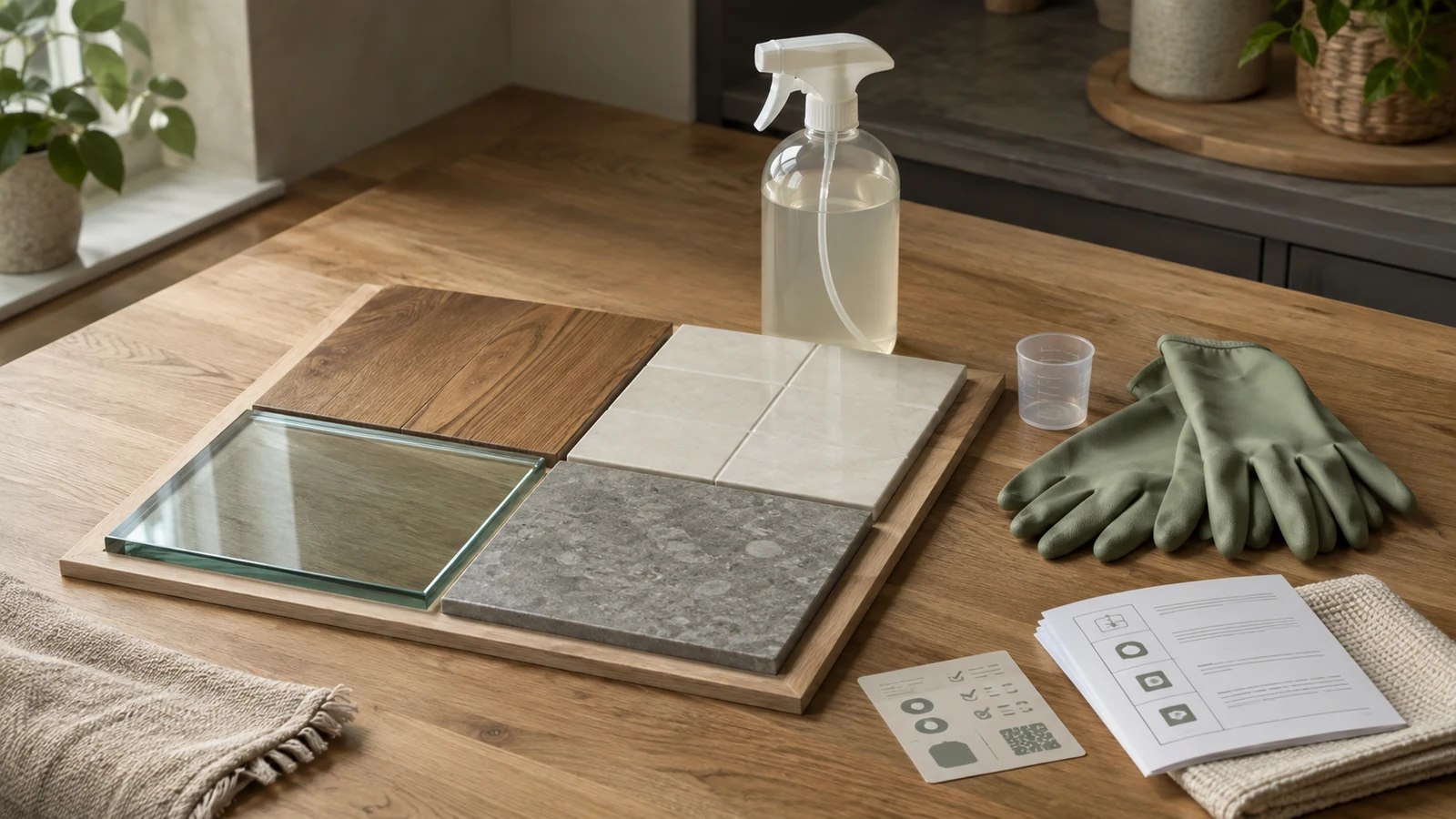
Evidence summary
This guide uses United States regulator, public-health, programme-owner, standards-owner and recall sources initially checked on July 27, 2026. The cited official routes and recall notices were rechecked on October 15, 2026. It is research-based. No household cleaner was purchased, mixed, applied or tested. No laboratory performance, toxicology, fragrance, packaging, lifecycle or household-outcome measurement was performed. Manufacturer or programme claims are attributed to their owners. Commercial relationship state is none declared; there are no monetized links.
This guide does not establish legal compliance, individual health suitability or product certification.
Quick answer
Start with the cleaning task and surface, not the front-label adjective. Decide whether you need ordinary soil removal or a registered disinfectant claim. Then verify the exact label use, dose, surface, safety directions and recall status.
Treat ingredient disclosure, Safer Choice, Green Seal, fragrance-free status, packaging format and local disposal as separate evidence layers. Keep a suitable product you already own when it already meets the task. Hold the purchase when the label, surface, registry, dose, fragrance, ventilation or disposal route is unknown.
A concentrate, refill or tablet can reduce some delivered material or shipping volume, while a ready-to-use product can reduce dilution error. Neither fact proves lower overall impact. Format comparison belongs to a separate research-based route; product testing belongs to a separate hands-on route.
The decision before the product
The same bottle cannot be judged apart from the task. Grease, soap scum, glass residue, a finished floor and a disinfecting claim impose different evidence requirements. “All-purpose” is a marketing category, not permission to use one formula on every finish. The exact surface and use directions control. When one product already handles the ordinary tasks in the household, adding another overlapping cleaner can add storage, confusion and packaging without changing the outcome.
Swipe horizontally to see all columns.
| Question | Evidence to record | Fail-closed result |
|---|---|---|
| Task | Exact soil and outcome: routine cleaning, degreasing, glass, bathroom soil, floor care or disinfecting | Hold when the task is vague |
| Surface | Material, coating or finish and exact product compatibility | Hold or reject a mismatch |
| Use directions | Dose, dilution, application, dwell/contact time, rinse and post-use steps | Do not improvise |
| Product identity | Exact name, size, variant, registration/listing and recall identifiers | Hold when identity is incomplete |
| Performance | Evidence matched to task, surface, soil, dose and method | Do not infer universal performance |
| Claims | Exact registered label or exact non-label attribute and qualification | Route to the correct trust method |
| Format | Ready-to-use, concentrate, refill, tablet or powder as a complete system | Do not rank package size alone |
| No purchase | Whether an owned suitable product already meets the need | Keep existing when it does |
Map the task before comparing formulas
Routine cleaning means removing ordinary soil from a compatible surface. Disinfecting is a separate pesticide-label decision. The CDC household cleaning and disinfecting guidance distinguishes cleaning from disinfecting and does not treat routine disinfection as a default for every surface. For a disinfectant claim, use the exact EPA registration number and current label, not a front-label word alone.
Swipe horizontally to see all columns.
| Task | Minimum evidence | Do not infer |
|---|---|---|
| General routine cleaning | Compatible surface, complete safety/use label, clear dose and task-specific performance evidence | Disinfectant activity |
| Kitchen grease | Exact kitchen surface and finish; label fit for grease and food-area use | Food-contact suitability without rinse directions |
| Bathroom soil | Exact fixture/finish compatibility and ventilation | Universal mold or pathogen control |
| Glass and mirrors | Exact glass/mirror use and streak-removal evidence | Fit for coated screens or specialty glass |
| Finished floors | Exact floor material, finish, dilution and residue route | Fit across wood, laminate, stone, vinyl and tile |
| Stone or sensitive finish | Exact manufacturer-compatible route | That “natural” or low-pH wording is enough |
| Food-contact surface | Exact use site plus rinse or post-use direction | That any household spray is food-contact suitable |
| Disinfecting | Exact EPA registration, product label, use site, method and contact time | Universal health protection |
| Odor concern | Identify and remove the soil/source where appropriate | That fragrance equals cleaning |
| Sensitive-person concern | Qualified health route and individual context | A universal allergy-safe product |
Routine cleaning is not the same as disinfecting
A product may clean soil without making a registered disinfectant claim. A registered disinfectant may require pre-cleaning, a defined application method, a wet contact time, ventilation, personal protection, rinsing or other post-use steps. The EPA pesticide-label framework makes the current label the use boundary. A guide cannot shorten the contact time, substitute a spray method, change the dilution or add an off-label surface.
For disinfecting, verify the exact product—not merely the brand—against the EPA registered disinfectant resources. DfE is a narrower exact-product route for certain registered disinfectants; the DfE certified disinfectant list does not turn registration into a broad endorsement or a permission to ignore the label.
Swipe horizontally to see all columns.
| Dimension | Routine cleaner | Registered disinfectant |
|---|---|---|
| Primary decision | Remove declared soil from a compatible surface | Use exact registered claim for exact use site/pathogen context |
| Identifier | Exact product and variant | Exact product and EPA registration number |
| Use instructions | Dose, application, surface and care directions | All routine directions plus exact contact time and label restrictions |
| Performance basis | Task/surface/soil matched evidence | Registration and label claim; not a universal cleaning winner |
| Food-contact surface | Exact compatibility and any rinse direction | Exact food-contact use site and required rinse/post-use direction |
| Improvisation | Not allowed when it changes label use or safety | Never create an unlisted method, dilution or contact time |
| Outcome | Bounded routine-cleaner candidate or hold | Bounded registered-disinfectant candidate or hold |
Surface compatibility is a hard gate
A formula that removes grease from a sealed counter may be unsuitable for an unsealed stone, specialty coating, finished wood, electronic screen or another sensitive surface. Finished-product hazard and use directions matter alongside ingredients. The CPSC household-product cautionary-label guidance focuses on the finished product and its required signal words, precautions, first aid and storage—not only on a list of ingredients.
Swipe horizontally to see all columns.
| Surface or context | Verify | Hold when |
|---|---|---|
| Sealed hard surface | Exact label names the material or a clearly equivalent category | The finish is unknown |
| Natural stone | Stone type, seal/finish and product compatibility | Only broad “gentle” wording is available |
| Finished wood | Finish and exact dilution/application route | Water, solvent or residue compatibility is unknown |
| Glass or mirror | Exact glass/mirror instruction | Product is intended only for other hard surfaces |
| Finished floor | Floor type, finish, residue and rinse route | One “floor” claim is being generalized across materials |
| Food-contact surface | Use site and rinse/post-use instruction | No exact food-contact direction exists |
| Electronic or specialty surface | Device/surface-maker route | A household cleaner is being generalized to a specialty coating |
| Mixed or unknown surfaces | Identify each material first | The household wants one formula to cover unknown finishes |
Read performance evidence at the same scope as the task
Performance is not a single universal number. A useful record identifies the soil, surface, dose, application method, comparison, scoring rule and conditions. The EPA Safer Choice Standard and criteria includes a performance route for labelled products, while the Safer Choice product list is still an exact-product registry—not a ranking of all products for every household task.
Manufacturer demonstrations, consumer reviews and programme thresholds answer different questions. This guide has no matched head-to-head testing. It therefore does not rank products or claim one formula cleans faster, leaves less residue, needs fewer passes or performs better at a lower dose.
Swipe horizontally to see all columns.
| Evidence | What it can support | What it cannot support |
|---|---|---|
| Current product label | Declared use, dose and restrictions | Independent superiority |
| Programme performance criterion | Programme-scoped admission requirement | Universal task winner |
| Manufacturer task claim | Attributed claim for exact product/task | Independent matched outcome |
| Current exact registry row | Programme membership at checked date | Every claimed feature or formulation detail |
| Matched independent test | Exact samples, protocol and conditions | Unobserved products or different tasks |
| User report | An attributed experience | Consensus, safety or controlled performance |
| Synthetic router fixture | Software behavior | Product performance |
Ingredients, hazard labels and marketing claims are different layers
Ingredient disclosure is useful transparency. It does not replace finished-product hazard labeling, exposure context or task performance. EPA’s Safer Chemical Ingredients List is ingredient-level evidence; an ingredient on that list does not confer the Safer Choice label on a finished cleaner. The exact product must pass the programme’s product-level route.
Broad “natural,” “non-toxic,” “chemical-free,” “plant-based” or “free-of” wording should not be accepted as self-proving. The FTC Green Guides summary requires environmental claims to be supportable and properly qualified. Natural/non-toxic and sensitive-population questions remain a separate trust and qualified-review route.
Swipe horizontally to see all columns.
| Claim or record | Evidence-safe use | Blocked shortcut |
|---|---|---|
| Ingredient disclosure | Record exact disclosed ingredients and date | Finished-product safety certification |
| SCIL ingredient | Ingredient-level programme evidence | Safer Choice product status |
| Safer Choice product row | Exact product-level programme status and notes | Brand-wide certification |
| Natural | Record claimant definition and narrow attribute | Safer, non-toxic or lower impact overall |
| Non-toxic | Exact supported scope and qualified evidence | Universal health/environment verdict |
| Free of | Exact substance/category, trace state, intentional-addition and substitute review | Zero exposure or zero risk |
| Chemical-free | Reject as literal broad formula description | A scientifically meaningful absence claim |
| Plant-based/biobased | Exact content/feedstock attribute | Biodegradable, recyclable or safer overall |
| Ingredient list alone | Transparency input | Performance, hazard or exposure conclusion |
Check exact registered labels, not decorative badges
Recognized programmes can add evidence when the exact product and current scope are verified. They do not collapse all product questions into one logo. The Safer Choice registry, DfE disinfectant list and Green Seal directory have different owners, criteria, identifiers and scopes. A brand partnership, ingredient-list status or retailer badge is not enough.
Swipe horizontally to see all columns.
| Programme or record | Exact lookup | What remains separate |
|---|---|---|
| EPA Safer Choice | Exact product/company/type/current row and notes | Task fit, current label, price and household preference |
| EPA SCIL | Exact ingredient record | Finished-product certification |
| EPA fragrance-free | Exact product and programme status | Universal allergy suitability |
| EPA DfE | Exact EPA registration number and listed product | Off-label use and endorsement |
| Green Seal GS-8 | Exact household cleaner listing and current standard scope | Every performance/environmental attribute |
| Green Seal GS-52 | Exact specialty household cleaner listing | Products outside that standard |
| Manufacturer seal | Claimant, criteria and evidence | Independent registered ecolabel |
| No result | Search record and date | That the product has never been certified |
Fragrance-free is not the same as unscented
When fragrance is a material buying constraint, verify the exact product and formulation route. EPA maintains specific fragrance-free criteria within Safer Choice. “Unscented,” “no noticeable odor” and “fragrance-free” are not interchangeable. Programme status also does not prove that a product is suitable for every person with asthma, allergies, migraine, pets or another sensitivity.
Swipe horizontally to see all columns.
| Wording or evidence | Treatment | Do not infer |
|---|---|---|
| Exact current fragrance-free programme row | Bounded programme evidence | Universal allergy safety |
| Manufacturer fragrance-free claim | Attributed claim; verify formulation evidence | Safer Choice status |
| Unscented | Treat as wording only unless formulation evidence exists | No fragrance materials |
| Contains fragrance | Record when material to buyer preference | Automatic hazard or performance conclusion |
| Odor-free after use | Separate sensory observation from formulation | Fragrance-free status |
| Sensitive-population outcome | Route to qualified health review | A universal product recommendation |
Compare the full format system, not the package headline
A ready-to-use spray, concentrate, refill pouch, tablet or powder can change dose control, storage, water addition, shipping volume and packaging. The relevant comparison includes the durable bottle or trigger, refill frequency, exact dose, usable prepared volume, water source, storage and local end-of-life route. EPA’s greener cleaning product guidance treats ingredients, performance, packaging and use instructions as separate considerations.
This buyer guide records the requirements but does not declare a format winner. A full concentrate/refill/ready-to-use comparison belongs to a separate research-based page. The EPA pollution-prevention framework describes source reduction, and EPA household guidance says to use only the needed amount of cleaning product and follow the label. Avoiding an unnecessary purchase is this guide’s bounded editorial inference when an already-owned product fits the task and label; it is not an EPA product finding or a measured impact comparison.
Swipe horizontally to see all columns.
| Format | Record the whole system | Common false shortcut |
|---|---|---|
| Ready-to-use | Bottle, trigger, net contents, dose, task coverage and local package route | Convenience proves lower impact |
| Concentrate | Concentrate amount, dilution, water, measuring tool, reusable container, storage and usable volume | Small package proves lower lifecycle impact |
| Refill | Refill contents, compatible original bottle/trigger, cleaning between refills, dose and refill availability | Refill always reduces impact |
| Tablet or powder | Tablet/powder dose, bottle, water, dissolution, storage and task limits | Low shipping mass proves better performance |
| Steam appliance | Exact appliance, surface, burn/electrical and recall route | No chemical formula means no risk |
| Keep existing | Remaining product, current task fit, label condition and storage | Buying a second product is necessary |
Swipe horizontally to see all columns.
| Field | Record | Hold when |
|---|---|---|
| Dose unit | Sprays, ounces, milliliters, capfuls, tablets or another exact unit | Unit is vague |
| Dilution ratio | Exact label ratio and water amount | A stronger mix is being improvised |
| Prepared volume | Usable volume per package | Only package size is known |
| Application | Cloth, mop, spray or other exact label method | Method is being substituted |
| Dwell/contact time | Exact if applicable | Time is missing or infeasible |
| Rinse/post-use | Exact surface-specific direction | Food-contact or residue route is unclear |
| Storage | Original container/label, closure, temperature and child/pet precautions | Safe storage cannot be met |
Packaging and disposal need local evidence
“Recyclable bottle,” “less plastic” or “refillable” should be recorded as exact attributes, not whole-product environmental conclusions. A material name or resin code does not prove local collection and downstream processing. Unused or hazardous household products can require a local household-hazardous-waste route; the EPA household hazardous waste guidance advises keeping products in original labelled containers and not mixing them.
Swipe horizontally to see all columns.
| Dimension | Evidence to retain | Unknown behavior |
|---|---|---|
| Primary container | Material, size/weight if known, closure and included trigger | Keep unknown rather than assume zero |
| Refill component | Material, number of doses and durable component reused | Do not call a pouch a complete system |
| Secondary packaging | Exact included box, film, inserts or none observed | Do not silently omit |
| Dose efficiency | Usable doses or prepared volume | Do not use package mass alone |
| Reusability | Compatible reuse, cleaning and service boundary | Do not assume indefinite reuse |
| Recycling | Exact local accepted item and preparation | Hold local claim |
| HHW/unwanted product | Local programme and original-label requirement | Do not default to drain or trash |
| Environmental conclusion | Separate approved lifecycle method | Do not rank from one package attribute |
Safety stop lines
Do not mix cleaners or disinfectants. Follow the exact finished-product label. Keep products in original labelled containers. Stop when the product is damaged, leaking, recalled or missing a readable label. Ventilation and protective measures must be feasible for the actual use. This guide does not provide emergency treatment or poisoning advice; use the product label and appropriate emergency or poison-control route for an actual exposure.
Swipe horizontally to see all columns.
| Condition | Result | Next safe action |
|---|---|---|
| Affected recall | Stop | Follow exact recall remedy |
| Recall status unknown | Hold | Identify exact product, size, date/lot and recheck |
| Leaking, damaged or unlabeled container | Stop or hold | Do not use; preserve label/remedy route |
| Plan to mix products | Stop | Use one exact labelled product route only |
| Surface unknown | Hold | Identify material and finish |
| Label-use mismatch | Reject | Select a compatible product or keep existing |
| Dose/dilution unknown | Hold | Obtain exact current label |
| Ventilation/PPE unavailable | Hold | Do not proceed with that use |
| Medical/allergy/pet/child outcome requested | Qualified route | Do not make a universal product claim |
Recall checks must match exact identifiers
Recall evidence is product-specific. The Fabuloso multi-purpose cleaner recall identifies exact products and lot-code ranges. The Pine-Sol recall identifies exact scented and professional product/date-code scope. The 2026 Angry Orange enzyme stain-remover recall is another exact product notice. A 2026 steam-cleaner recall covers an appliance hazard and should not be generalized into a conclusion about every non-chemical cleaning method.
Swipe horizontally to see all columns.
| Notice | Exact boundary to verify | Do not infer |
|---|---|---|
| Fabuloso multi-purpose cleaners | Product name, size and lot code in notice | Every Fabuloso product is recalled |
| Pine-Sol scented/professional cleaners | Exact product and date-code scope | Every Pine-Sol product is recalled |
| Angry Orange enzyme stain remover | Exact affected item/remedy | Every enzyme cleaner is recalled |
| Dupray steam cleaner | Exact appliance model and remedy | Steam is universally unsafe or safer |
| No current match found | Search date and identifiers used | Universal safety clearance |
A task-first buying workflow
- List the cleaning tasks. Separate ordinary soil removal from disinfecting.
- List the surfaces and finishes. Do not group sensitive materials under “hard surface.”
- Inspect suitable products already owned. Check label condition, recall status, task fit and remaining quantity.
- Freeze the exact product candidate. Record name, size, variant, seller/market if price is later used, label and registration or programme identifiers.
- Read the safety and use label. Record dose, dilution, application, dwell/contact time, rinse, ventilation, PPE, storage and disposal.
- Check performance at the same task scope. Attribute manufacturer claims and avoid unmatched rankings.
- Check claims and programmes separately. Use exact Safer Choice, DfE or Green Seal registry routes; route broad claims to the trust framework.
- Compare format as a complete system. Include durable bottle/trigger, refill or concentrate, dose, water, prepared volume, storage and local end of life.
- Choose a bounded outcome. Keep existing, use a routine-cleaner candidate, use an exact registered-disinfectant candidate, route to format comparison, or hold.
Swipe horizontally to see all columns.
| Outcome | When it applies | What it does not mean |
|---|---|---|
| Keep existing / no purchase | Owned suitable product meets task, surface, label and safety needs | The owned product is universally best |
| Bounded routine-cleaner candidate | Task, surface, label, dose, safety and performance evidence pass | Recommendation across all products |
| Registered disinfectant candidate | Exact registration and exact label use pass | Off-label use or universal protection |
| Registered-label lookup | Exact programme claim is material | Product winner or brand-wide certification |
| Format comparison route | Concentrate/refill/RTU trade-off is decisive | This guide has selected a format winner |
| Trust-route review | Broad environmental, natural or non-toxic claim is material | The claim is true or false before review |
| Hold | Central evidence is missing, stale or conflicting | Unknown is zero or harmless |
| Stop | Recall, damage or mixing plan | A workaround should be invented |
What this guide could not verify
- No universal cleaning-product winner, safest product or lower-impact product.
- No matched household performance, stain, residue, odor, dose, toxicity, allergy, packaging or lifecycle test.
- No current price comparison, checkout total, cost per use, payback or lifecycle-cost result.
- No product recommendation, affiliate relationship or commercial CTA.
- No local recycling, refill or hazardous-waste availability for an unspecified location.
- No legal, pesticide-enforcement, medical, allergy, child, pet or sensitive-population conclusion.
- No claim that a programme label verifies every environmental, health, performance or packaging attribute.
Update triggers
Recheck the evidence when a product label, formula, exact programme row, standard, registry schema, recall, use direction, packaging system, refill route, performance claim, ingredient disclosure, or local disposal route changes. A current product check should revisit exact recalls, Safer Choice, DfE, Green Seal and label-use sources.
Bottom line
Choose the smallest, simplest evidence-backed cleaning route that fits the actual task and surface. Keep a suitable product already owned when it works. Separate ordinary cleaning from registered disinfecting. Verify exact labels and registries, treat natural/non-toxic and broad green wording as claims that need scope, compare concentrate/refill/ready-to-use as complete systems, and stop rather than improvise when recall, damage, mixing, surface, dose or ventilation information is unresolved.
Related reading
- How to verify environmental claims on household products — preserve exact wording, subject and evidence scope.
- Natural and non-toxic cleaning claims — keep ingredient, product and health conclusions separate.
Method and sources
The decision method behind this guide uses a deterministic, non-scoring, fail-closed router. It checks exact task, surface compatibility, cleaning-versus-disinfecting, EPA registration state, label fit, safety label, recall, damage, mixing, ventilation, sensitive-population scope, existing-product preference, performance evidence, claim type, registry state, fragrance need, format, dose and local end-of-life state. It can preserve bounded candidates, keep-existing, trust routes, format routes, holds and stops. It cannot select a brand, award a score, issue a health/legal/certification verdict.
Synthetic checks validate routing logic only. They do not establish product performance or household outcomes.
The official routes below support the specific discussion beside each citation. Programme descriptions, exact product instructions, registry scope and current recall identifiers remain separate evidence layers. A source route is not a product recommendation or a household performance result.
- CDC household cleaning and disinfecting guidance
- EPA pesticide-label framework
- EPA registered disinfectant resources
- DfE certified disinfectant list
- CPSC household-product cautionary-label guidance
- EPA Safer Choice Standard and criteria
- Safer Choice product list
- Safer Chemical Ingredients List
- FTC Green Guides summary
- Green Seal directory
- specific fragrance-free criteria
- greener cleaning product guidance
- EPA pollution-prevention framework
- EPA household guidance
- EPA household hazardous waste guidance
- Fabuloso multi-purpose cleaner recall
- Pine-Sol recall
- 2026 Angry Orange enzyme stain-remover recall
- 2026 steam-cleaner recall
- Green Seal GS-8 household cleaning scope
- Green Seal GS-52 specialty household cleaning scope
- CDC bleach and disinfectant precautions