
Evidence summary: This research-based U.S. product-line map uses EcoFlow’s current official store, product, manual, warranty, and support pages plus the U.S. Consumer Product Safety Commission recall record checked July 23, 2026. EcoFlow’s specifications and lab claims are attributed to EcoFlow; no unit was purchased, borrowed, opened, measured, or ranked. Prices and stock statuses were recorded internally because they change too quickly to support this evergreen public guide. No affiliate relationship or monetized link applies.
Product and model information checked: July 23, 2026
Warranty and recall information checked: July 23, 2026
Hands-on testing: None
Commercial relationship: None declared
Quick answer
Do not choose an EcoFlow model by brand, capacity label, sale badge, or the phrase “home backup.” Start with the requirements already established in the renter-readiness, claim-literacy, safety, category-fit, and sizing steps: delivered energy, simultaneous continuous watts, one declared startup event, output types, charging route, storage route, carry route, permission, and whether the plan remains temporary plug-in use.
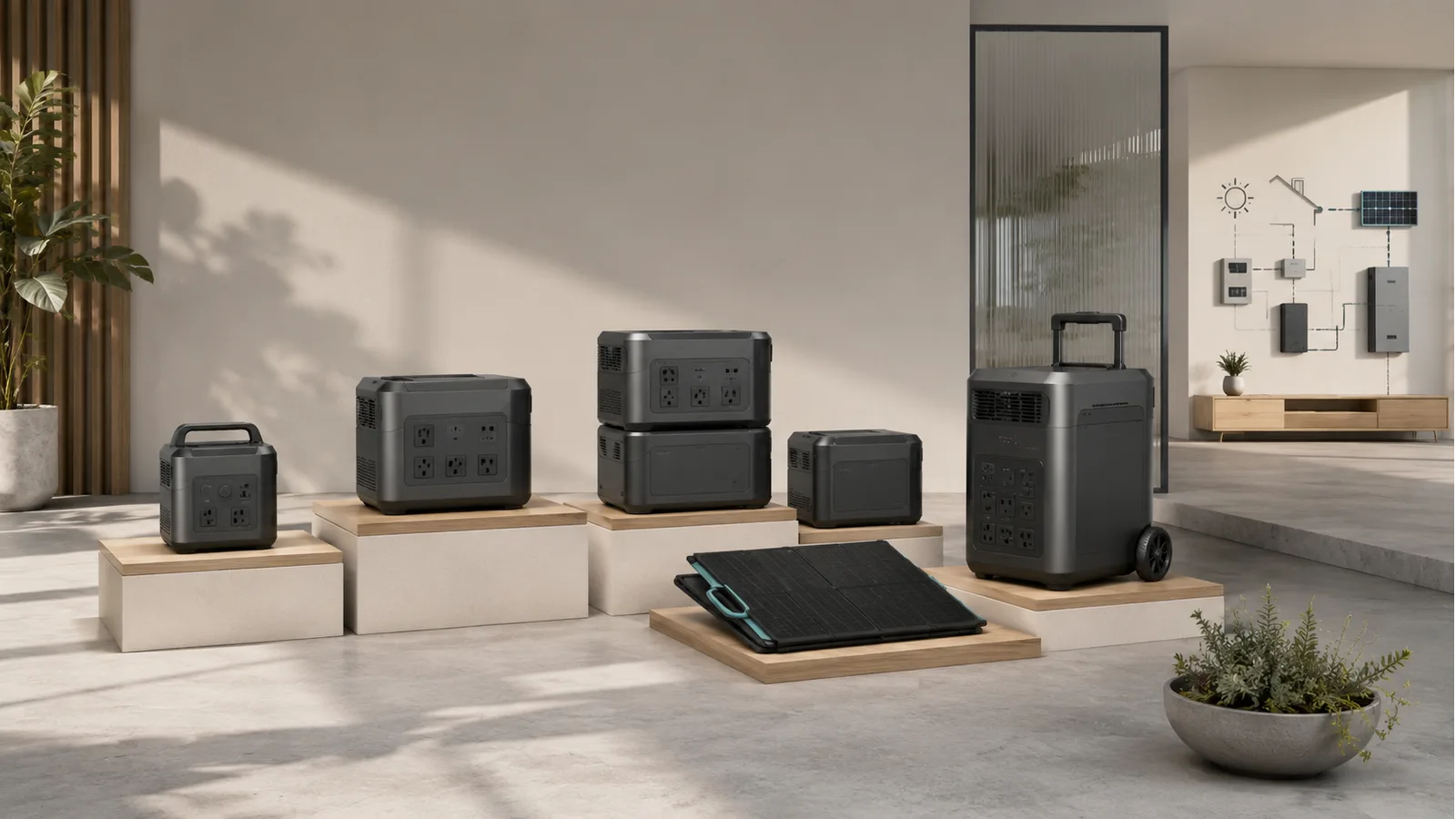
The current U.S. EcoFlow range spans compact RIVER units, roughly 1 kWh DELTA 3 units, 2 kWh and 3 kWh DELTA 3 units, the wheeled 120/240 V DELTA Pro 3, and installed whole-home systems. Those are different ownership projects. A higher number does not automatically make a better fit, and a model that crosses into transfer equipment, an inlet, a panel, fixed solar, or 120/240 V premises integration requires a separate qualified project rather than an ordinary portable-power purchase.
Use this guide to remove unsuitable families. It does not name a winner.
Stop condition: Do not shortlist an exact unit until its U.S. model identifier, current manual, input and output limits, recall status, warranty terms, physical route, charging/storage location, and declared load requirements have all been checked.
Before using this product-line map
This page assumes you have already completed these decisions:
- whether backup-power shopping is appropriate for the household;
- what watt, watt-hour, surge, usable-energy, efficiency, and cycle claims do and do not establish;
- the relevant fire, battery, charger, storage, recall, and no-backfeeding boundaries;
- which portable-power product family and features fit the space;
- the delivered-energy, continuous-output, and startup-event requirements.
This article does not replace those pages. It applies their outputs to one manufacturer’s current U.S. line.
The current EcoFlow range is not one decision
EcoFlow’s official U.S. store currently presents overlapping generations and bundles. The same family name can appear as a base unit, a “Plus” unit, a bundle with an extra battery, or a solar-generator package. Some older DELTA 2 and original DELTA Pro listings remain alongside newer DELTA 3 and DELTA Pro 3 products.
That means the store is not a clean taxonomy. Record the exact product page, model identifier, market, included components, and checked date. Do not treat a family name or collection tile as proof that two listings have the same ports, expansion path, warranty, charger, transfer behavior, or current status.
Product-family map
The values below are manufacturer-stated U.S. specifications, not independent measurements. “Rated capacity” is not guaranteed delivered AC energy, and X-Boost is not a substitute for the rated-output, surge, startup, or compatibility checks described elsewhere.
| Family or exact current example | Manufacturer-stated capacity | Rated AC output | Physical and charging signal | What the family may help you screen | What it does not prove |
|---|---|---|---|---|---|
| RIVER 3 | 245 Wh | 300 W | 7.8 lb; up to 110 W solar; under 20 ms transfer claim | Very small declared loads, communications, lighting, and a highly constrained carry/storage route | Appliance compatibility, useful runtime, or enough energy for the household |
| RIVER 3 Plus | 286 Wh | 600 W | 10.4 lb; up to 220 W solar; under 10 ms transfer claim; optional expansion to 858 Wh | Small loads where more ports, output, or a documented expansion route matter | That 1,200 W X-Boost equals ordinary 1,200 W continuous compatibility |
| DELTA 3 Classic | 1,024 Wh | 1,800 W | About 26.7 lb; up to 500 W solar; 10 ms transfer claim | A carryable 1 kWh-class station when the declared loads fit 1,800 W and the lift/storage route works | Delivered energy, runtime, startup compatibility, or an expansion route |
| DELTA 3 Plus | 1,024 Wh | 1,800 W | 1 kWh class; up to 1,000 W solar across documented inputs; expansion claims up to 5 kWh; 10 ms transfer claim | A 1 kWh starting point when faster solar input, more ports, or an approved expansion path matters | That every extra battery or panel is compatible, or that expansion is economical |
| DELTA 3 Max | 2,048 Wh | 2,400 W | About 44.8 lb; up to 500 W solar; 10 ms transfer claim | A heavier 2 kWh-class station when 2,400 W rated output and the physical route fit | That X-Boost or 4,800 W surge establishes appliance compatibility |
| DELTA 3 Max Plus | 2,048 Wh | 3,000 W | About 48.7 lb; up to 1,000 W solar; documented 2–10 kWh expansion; 10 ms transfer claim | A higher-output 2 kWh base when exact expansion and charging paths are justified | That the household needs 10 kWh, or that the expanded system remains portable |
| DELTA 3 Ultra | 3,072 Wh | 3,600 W | About 72.1 lb; up to 800 W solar; under 10 ms transfer claim | A high-output 3 kWh unit when the lift, storage, charging, and outlet requirements are practical | That “Ultra” means whole-home coverage or universal device support |
| DELTA 3 Ultra Plus | 3,072 Wh | 3,600 W | About 74.3 lb; up to 1,600 W solar; documented expansion up to 11 kWh; under 10 ms transfer claim | A 3 kWh expandable route when the exact extra-battery system and physical burden are acceptable | Guaranteed outage duration, simple apartment suitability, or permission |
| DELTA Pro 3 | 4,096 Wh | 4,000 W at 120/240 V | Wheeled; about 113.5 lb; up to 2,600 W solar; 10 ms transfer claim | A large mobile base where 120/240 V outlets and a much heavier transport route are genuinely required | That a dwelling can be energized without approved transfer equipment, permits, and qualified work |
| DELTA Pro Ultra / Ultra X | Multi-component installed systems | Whole-home-class 120/240 V systems | Separate inverter and battery modules; Smart Home Panel and installation routes | A signal that the decision has left ordinary portable plug-in backup and become a home-energy project | Renter permission, plug-and-play premises integration, installed cost, or suitability |
Sources for the exact rows are the EcoFlow RIVER 3 page, RIVER 3 Plus page, DELTA 3 Classic page, DELTA 3 Plus page, DELTA 3 Max page, DELTA 3 Ultra page, DELTA Pro 3 page, and DELTA Pro Ultra X page.
Remove families that fail the declared load requirement
Use the sizing record rather than a marketing example.
Compare:
- required simultaneous continuous output with the exact station’s rated continuous output;
- the one declared startup event with the exact manual’s applicable surge and output conditions;
- required output types with the exact port types and per-port limits;
- required delivered energy with the range established by the sizing method—not merely the battery’s nameplate watt-hours.
Do not substitute X-Boost for compatibility. EcoFlow presents X-Boost separately from rated output and surge output. That alone is enough reason to preserve the distinction. A resistive heating load that operates in a proprietary mode is not evidence that a compressor, motor, medical device, power supply, or other load is supported.
If the declared requirement is missing, stop and return to sizing. Do not choose the largest affordable unit as a proxy.
Remove families that fail the physical route
Weight changes the ownership decision before electrical features do.
Check the complete route:
- delivery point to storage;
- storage to charging location;
- charging location to use location;
- stairs, elevators, door thresholds, narrow turns, and lifting height;
- whether one person can safely move the unit;
- whether extra batteries, cables, and panels must travel with it;
- whether the unit can remain stored according to the exact manual.
The difference between roughly 8–10 lb, 27 lb, 45–49 lb, 72–74 lb, and more than 110 lb is not a minor feature difference. A wheeled product can still fail on stairs, a threshold, an elevator outage, or an inaccessible storage route.
A product that cannot be moved or stored as planned is not a portable solution for that household.
Treat expansion as a separate purchase path
An expansion claim creates dependencies:
- exact base-station model;
- exact supported extra battery;
- maximum number of batteries;
- required cable or adapter;
- combined dimensions and weight;
- storage and charging locations;
- firmware or app requirements;
- warranty terms for each component;
- whether the expanded system still serves the original renter or small-home scenario.
Do not assume one EcoFlow extra battery works with another family. The current official pages describe different expansion paths: RIVER 3 Plus uses its documented EB300 or EB600 route, DELTA 3 Plus lists compatible extra-battery paths, DELTA 3 Max Plus and DELTA 3 Ultra Plus have their own scaling claims, and DELTA Pro 3 uses its specified extra battery.
Expansion is not evidence that the base model is the right purchase. It may instead reveal that the initial product family is too small or too physically complex.
Treat charging input as a site constraint
A higher solar-input number is useful only when the site has:
- a compatible panel or approved arrangement;
- the correct voltage, current, connector, cable, and polarity;
- temporary placement permission;
- safe cable routing;
- suitable weather and charging-temperature conditions;
- enough usable solar time for the declared plan.
Use the portable-panel compatibility guide before connecting solar. Use the solar-recharge calculator only after compatibility is established and every range is supplied explicitly.
AC fast-charge claims also need a real circuit, charging location, and manual-compliant conditions. “Fast” does not override building rules, heat, damaged-equipment warnings, or the exact charger and circuit limits.
Read UPS and transfer claims narrowly
EcoFlow publishes transfer-time claims such as under 20 ms, 10 ms, or under 10 ms on current pages. These are manufacturer claims for defined conditions, not a guarantee that every connected load will continue without interruption or operate correctly.
Before relying on backup transfer:
- identify the exact model;
- read the current manual;
- confirm whether the relevant outlets are part of the UPS/EPS path;
- confirm load and bypass limits;
- identify app, firmware, or computer-software dependencies;
- test only in a safe, non-critical context;
- keep a separate continuity plan for high-consequence equipment.
A transfer-time number does not establish medical-device compatibility, data integrity, or an acceptable recovery plan.
Separate temporary plug-in backup from premises integration
RIVER and DELTA units can be used as portable plug-in power only within their exact instructions and the site’s permission constraints.
The decision changes when the proposal includes:
- a home inlet;
- a manual transfer switch;
- a Smart Home Panel;
- fixed solar;
- branch circuits;
- 120/240 V premises loads;
- automatic whole-home transfer;
- parallel inverters;
- permits, inspections, or utility interaction.
EcoFlow’s DELTA Pro 3 page explicitly presents Smart Home Panel, inlet-box, and manual-transfer-switch routes. Those are not instructions for a renter or an unqualified installer. They are evidence that the project has crossed into a separately approved installation and premises-wiring scope.
Do not backfeed a dwelling through an improvised cord or outlet.
Check the exact recall identifier
The U.S. Consumer Product Safety Commission recalled the EcoFlow DELTA Max 2000, model EFD310, on October 9, 2025 because recalled units could overheat and ignite. The remedy is a firmware repair, and CPSC instructs consumers to stop using the recalled unit and contact EcoFlow for the remedy.
This is an exact model recall. It is not evidence that every DELTA, DELTA Max, or current EcoFlow product is recalled. It is also not a reason to skip the check.
Before purchase or use:
- find the exact model identifier on the product and packaging;
- search the current CPSC recall database and EcoFlow recall information;
- follow the exact remedy when an identifier matches;
- stop when the identity cannot be confirmed.
See the CPSC recall notice for model EFD310.
Read warranty terms by exact product and market
EcoFlow’s U.S. warranty policy applies to products purchased in the United States and describes standard coverage in the contiguous United States, with shipping and support limitations for Alaska, Hawaii, Puerto Rico, Guam, the U.S. Virgin Islands, and other territories. It also ties some extended periods to product registration.
Do not summarize the whole line as “five-year warranty.” The current policy and exact product pages show different structures, including 24 months for RIVER 3, five years for RIVER 3 Plus and several products, and three-year standard plus two-year app-registration extensions for some newer DELTA 3 products.
Before relying on a warranty:
- confirm the exact model row in the current policy;
- confirm seller authorization and proof-of-purchase requirements;
- confirm whether registration is required;
- confirm the buyer’s location and logistics burden;
- save the checked terms with the purchase record.
A longer stated warranty does not prove greater real-world performance or lower ownership cost.
Read the current U.S. EcoFlow warranty policy.
Why this guide does not publish prices
EcoFlow’s official store was actively showing discounts, bundles, preorder or sold-out states, member pricing, and overlapping collection pages when checked on July 23, 2026. A price copied into an evergreen article could become wrong immediately and could make a model look preferable for a temporary promotion.
The research packet retains a dated internal snapshot so future release review can detect material changes. This public guide deliberately does not show a price, sale percentage, deal verdict, or value ranking.
Price belongs in a separately maintained, date-stamped price record with seller, market, bundle contents, taxes, shipping, and availability—not in a permanent model recommendation.
Commercial status and independence
Measured Habitat has no active EcoFlow affiliate relationship and no approved monetized link for this article.
EcoFlow’s official contact page lists an affiliate-program contact, and several retailers operate application-based creator or affiliate programs. A public contact or application page is not acceptance, operator eligibility, a commission guarantee, or evidence that a product deserves coverage.
This article would exist in the same form without a commercial route. Commercial-access evidence cannot enter the product evidence, family map, inclusion logic, or conclusions.
A practical family-elimination worksheet
Record one line for each family still under consideration.
| Check | Required household value | Exact model value/source | Pass, fail, or unresolved |
|---|---|---|---|
| Delivered energy | From the sizing worksheet | Do not substitute nameplate Wh | |
| Continuous output | Declared simultaneous watts | Exact rated AC output | |
| Startup event | Declared watts and duration | Exact applicable manual limit | |
| Output types | AC, USB-C, USB-A, 12 V, other | Exact per-port and combined limits | |
| Carry route | Weight, stairs, doors, lifting | Exact unit plus accessories | |
| Storage route | Space and manual conditions | Exact unit plus extra batteries | |
| Charging route | AC, vehicle, compatible solar | Exact inputs and site constraints | |
| Expansion | Needed or not needed | Exact battery/cable/maximum | |
| Transfer behavior | Required or not required | Exact outlets, limits, and manual | |
| Recall | Exact identifier checked | Current CPSC/manufacturer result | |
| Warranty | Market and logistics acceptable | Exact current policy | |
| Permission | Building/site route confirmed | Written local answer where needed |
Any unresolved safety, permission, identity, compatibility, or high-consequence continuity item is a stop—not a reason to select the larger unit.
When no EcoFlow family remains suitable
“No suitable EcoFlow family” is a valid outcome.
Possible next actions include:
- keep the current no-purchase preparedness plan;
- use a smaller existing battery, charged communications, safe lighting, coolers, or relocation planning;
- compare a materially different battery-station brand only after applying the same evidence fields;
- compare a fuel-generator route only when its outdoor carbon-monoxide, fuel, weather, noise, and permission constraints can be met;
- redesign the declared loads;
- separate critical continuity from convenience;
- treat whole-home backup as a qualified building project rather than a portable-product purchase.
Do not lower the evidence standard merely to keep one brand in the shortlist.
What remains unknown
This guide does not establish:
- the delivered AC energy or runtime of any model;
- compatibility with a particular appliance, compressor, motor, power supply, or medical device;
- the condition of an individual unit;
- current stock, final checkout price, tax, shipping, installation, or bundle value;
- whether a building, lease, insurer, fire authority, electrical authority, or utility permits the proposed use;
- whether an app, firmware, UPS feature, or accessory will behave as expected in the reader’s environment;
- whether an older-generation listing is a better value than a current-generation listing;
- whether any EcoFlow model is superior to another brand.
Those questions require separate current evidence.
Related decision handoffs
- Renter and building readiness: category-entry and stop conditions.
- Capacity and runtime claims: what W, Wh, usable energy, surge, efficiency, and cycle claims mean.
- Portable-station safety: condition, recall, charging, storage, backfeeding, and escalation.
- Category and feature fit: whether a portable power station is the right product class.
- Sizing: declared delivered energy, continuous watts, and one startup event.
- Battery versus fuel generator: materially different backup routes.
- Portable solar compatibility: exact panel/station input fit.
- Solar recharge: explicit-range active charging-time model.
- Price tracking: a future dated maintained record, not this article.
- Hands-on review: only after exact product access and a preregistered test protocol.
Method and sources
The product-line map was built from current U.S. official product and collection pages. Each specification remains manufacturer-attributed. Current manual access is routed through the EcoFlow download center. Warranty scope comes from EcoFlow’s U.S. policy. Recall scope comes from CPSC.
A bounded public search observation found product-line navigation, “which model,” family comparison, and RIVER-versus-DELTA result families. That supports keeping a distinct brand-line analysis, but it does not establish search volume, ranking probability, traffic, conversion, or population demand.
The commercial-route review checked public official pages only. No application, account, private terms, affiliate identifier, tracking link, or compensation was created.
Recheck every material product page, warranty row, recall record, model status, and public relationship statement immediately before WordPress publication and at least every 30 days while the page remains live.