
Evidence summary: This guide uses current Renogy U.S. product and support pages, exact electrical fields from official Renogy records, CPSC recall-search records, and a deterministic compatibility method checked on July 24, 2026. Manufacturer specifications are attributed examples, not independent performance or safety proof. No component was purchased, installed, wired, measured, ranked, or recommended. Public prices and affiliate links are intentionally excluded.
Product and source check: July 24, 2026
Recall-search check: July 24, 2026
Compatibility method: c13-ecosystem-compatibility-method-v001
Commercial relationship: None declared
Hands-on or installation testing: Not performed
Quick answer
“Renogy ecosystem” does not describe one universal plug-and-play system.
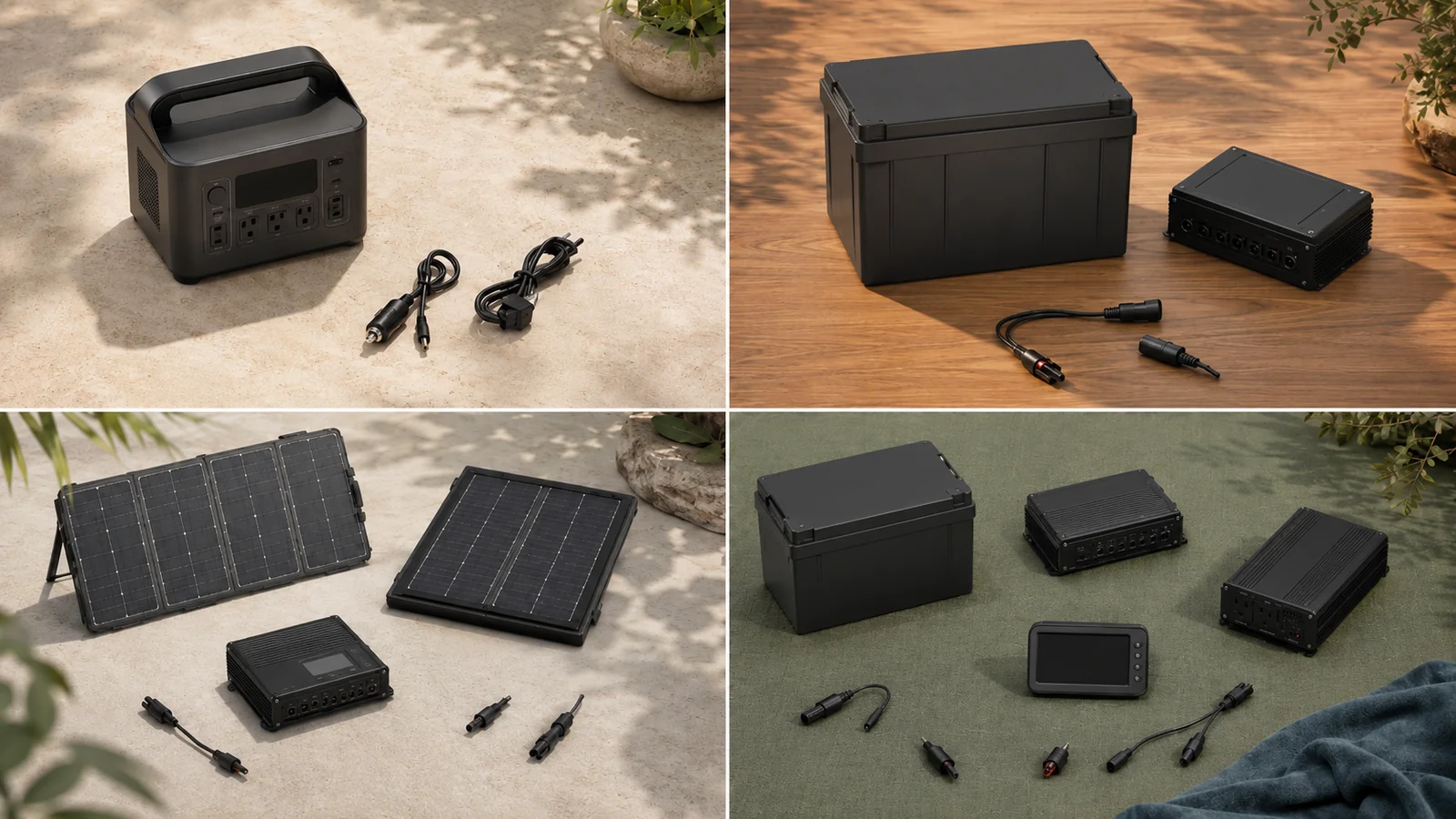
The current catalog contains several different architectures:
- an all-in-one AC portable power station;
- a 12V battery that becomes a DC power hub with a dedicated accessory;
- portable solar panels sold either as raw-panel products or as battery-charging kits with a charge controller;
- modular 12V batteries, charge controllers, inverters, monitors, cables, and protection devices;
- multiple app or monitoring paths whose support depends on the exact device.
Parts from different lanes may share the Renogy name and still require different voltage, current, connector, charge-controller, firmware, and installation decisions.
The safe workflow is:
identify the exact source and target
→ identify whether the path carries raw PV, regulated DC, battery DC, or AC
→ compare voltage, current, power, connector, polarity, and controller role
→ review cold open-circuit voltage and multi-panel arrangement
→ separate temporary plug-in use from a modular or premises-integration project
→ hold when any required field is unknown
A connector that physically fits is not enough. A “works with most power stations” statement is not an exact compatibility verdict.
Start with the right decision path
Use the foundation pages before this ecosystem map:
- the renter and building readiness preflight;
- the explanation of W, Wh, continuous output, surge, and calculated runtime;
- the portable-power safety and recall checks;
- the category and feature guide;
- the static load-sizing worksheet;
- the portable-solar compatibility guide.
This page does not size a battery, calculate runtime, predict solar recharge time, approve a panel location, or authorize wiring. It only explains which Renogy architecture a declared use case belongs to and which compatibility fields must still pass.
After the portable-panel compatibility checks are resolved for the exact setup, use the solar recharge time calculator only to model explicit energy and accepted-power ranges. Its arithmetic does not establish compatibility, forecast weather, or measure a Renogy product’s charging performance.
Four different Renogy power paths
| Architecture | Current example | What it provides | What it does not establish |
|---|---|---|---|
| All-in-one AC station | PowerStation 2000 | Integrated battery, inverter, AC/DC/USB outputs, solar input, TT-30 outlet, app monitoring | External-battery expansion, universal panel compatibility, appliance compatibility, or premises integration |
| Battery plus DC hub | PowerMax 100Ah + MaxHub | 12.8V battery, USB and low-voltage DC outputs, limited solar/USB-C charging | Built-in 120V AC inverter or equivalence to an all-in-one power station |
| Portable panel or suitcase | 400W lightweight suitcase; 200/400W blanket | Raw photovoltaic output when sold without a controller | A safe connection to every station or battery |
| Modular 12V system | panel + charge controller + battery + inverter + monitor | Configurable battery and AC/DC system | Consumer plug-and-play use, code compliance, or a portable-product workflow |
The practical first question is therefore not “Which Renogy product is best?” It is “Which architecture is being proposed?”
PowerStation 2000: the all-in-one AC lane
The current Renogy PowerStation 2000 page lists:
- 2,048Wh;
- 2,400W continuous AC output and 3,600W surge;
- five 120V AC outputs plus a TT-30 outlet;
- a 12–60V DC input window, 25A maximum input current, and 1,200W maximum DC input;
- about 51.81lb;
- a transfer-time claim of no more than 20ms;
- pass-through charging;
- PowerStation Manager app monitoring on the current product material.
Those fields make it the clearest Renogy route when the declared requirement is temporary plug-in AC power and the exact load, startup, weight, storage, charging, and safety gates have already passed.
They do not prove:
- delivered AC energy or runtime;
- that every 2,400W load will start;
- that every attached device will tolerate the transfer behavior;
- that a named solar panel has the correct cable and polarity;
- that the TT-30 outlet is a household wiring route;
- that the station may be connected to a panel, inlet, transfer switch, or building circuit.
Boundary: An RV TT-30 outlet is not permission to backfeed a home or improvise a premises connection.
PowerMax plus MaxHub: a DC lane, not the same product class
The current PowerMax 100Ah and MaxHub page lists a 12.8V, 100Ah, 1,280Wh LiFePO4 battery. With the dedicated MaxHub, the page lists USB-C, USB-A, an Anderson DC path, and an 11–25V, 4.2A, 84W maximum solar input.
The current record does not list a built-in 120V AC inverter in the MaxHub.
That means PowerMax may fit a declared DC-only use case—such as low-voltage accessories or a documented DC refrigerator path—without being equivalent to PowerStation 2000.
It also creates a compatibility trap:
- a panel may have a suitable voltage but exceed the MaxHub current or power limit;
- a “100W panel” label alone does not prove the exact electrical path is accepted;
- adding a separate inverter changes the project into a modular battery system;
- series/parallel battery use and any fixed installation require a separate exact design and safety route.
Portable panels: raw PV and controlled battery kits are different
400W lightweight portable suitcase
The current 400W lightweight portable suitcase page lists:
- 400W at standard test conditions;
- 47.2V open-circuit voltage;
- 11A short-circuit current;
- 40V maximum-power voltage;
- 10A maximum-power current;
- about 30.2lb;
- a solar-connector output;
- a three-year materials and workmanship warranty.
A single panel’s published electrical values fit inside the PowerStation 2000’s published 12–60V, 25A, 1,200W DC-input ceiling.
That still does not make the combination a final compatibility verdict. The exact current station manual, supplied or approved cable, connector type, polarity, cold-condition open-circuit voltage, and single-panel configuration must all be confirmed. If one field is missing, the method returns hold.
100W and 200W suitcase kits with a controller
Renogy also sells portable suitcase kits with a preinstalled Voyager PWM charge controller and alligator-clip battery leads.
The current 100W kit page lists:
- 21.47V open-circuit voltage;
- 6.029A short-circuit current;
- 18.65V maximum-power voltage;
- 5.602A maximum-power current;
- a Voyager 20A controller and fused alligator-clip cable.
The current 200W kit page lists the same 21.47V open-circuit voltage with 11.89A short-circuit current and 11.05A maximum-power current.
These are battery-charging kits. Their controller output is not the same thing as raw panel input to a portable power station. Do not connect a regulated controller output to a station’s raw-PV port unless the exact manuals explicitly define that path.
Solar blanket and cross-brand use
The current Renogy 200/400W solar blanket page states that the panels can charge batteries through a charge controller and may be used with non-Renogy power stations through an adapter cable, while instructing users to check the target power-station specifications.
That is a useful compatibility boundary, not a universal promise.
For any external station, record:
- exact blanket model and U.S. SKU;
- open-circuit and maximum-power voltage;
- short-circuit and maximum-power current;
- station input window, current limit, and power limit;
- exact adapter and polarity;
- cold-voltage review;
- whether multiple panels are authorized.
A worked compatibility screen
The examples below are method demonstrations, not installation or purchase recommendations.
| Proposed path | Method result | Reason |
|---|---|---|
| One 400W lightweight suitcase → PowerStation 2000, exact cable/polarity confirmed, cold review passed | Direct-PV candidate | Published voltage, current, and power values fit the published input ceiling |
| The same panel → PowerStation 2000, connector or polarity unknown | Hold | Electrical plausibility cannot replace an exact connection path |
| Two 400W suitcases in series without an approved arrangement | Hold | Series voltage and cold Voc require exact manufacturer review |
| 100W suitcase kit controller output → PowerStation 2000 raw-PV input | Architecture mismatch | Regulated battery-controller output is not raw PV |
| 100W raw panel values → PowerMax MaxHub | Current/power review required | 5.602A and 100W exceed the MaxHub’s listed 4.2A and 84W limits; do not assume clipping |
| 400W suitcase → Rover 40A controller → 12V battery | Modular 12V project | Controller, battery profile, cable, fuse, enclosure, inverter, and installation decisions remain |
| Renogy blanket → another brand’s station | Cross-brand candidate only after exact checks | Adapter availability and brand wording do not replace electrical and polarity checks |
| Any panel or battery route into household circuits | Separate integration project | Permission, listed transfer equipment, exact manuals, and qualified electrical review control |
The modular 12V lane is a system project
The current Rover 40A MPPT controller record lists 12/24V auto-detection, a 15–100V PV open-circuit range, and maximum PV input of 520W at 12V or 1,040W at 24V.
The current Core 12V 100Ah Bluetooth battery page lists 1,280Wh, 150A continuous discharge, Bluetooth monitoring, and model-specific series/parallel limits.
The current 2,000W inverter page describes a separate 12V inverter with a UPS transfer function and built-in Bluetooth.
These three product families can participate in a modular system, but they are not a preapproved bundle merely because they share a brand.
A valid design still needs:
- exact nominal and operating voltage;
- charge profile and battery chemistry;
- controller PV ceiling and power limit;
- battery continuous and peak current;
- inverter continuous and surge current demand;
- cable ampacity, length, terminals, protection, disconnects, enclosure, ventilation, and mounting;
- grounding and any neutral behavior;
- permission and qualified review where required.
This article intentionally provides no wiring diagram, conductor size, fuse size, grounding instruction, or transfer-equipment procedure.
Apps and monitors are product-specific
Current Renogy pages name different software and monitoring routes:
- PowerStation 2000 product material names the PowerStation Manager app;
- current smart-battery pages name the Renogy App;
- the Renogy ONE Core G3 page describes a separate monitoring and automation platform.
Those names do not prove that every device appears in one app, that data is shared across all product families, or that cloud and offline functions are equivalent.
Before treating monitoring as a requirement, confirm:
- exact supported device and firmware;
- local Bluetooth versus account, Wi-Fi, or cloud dependence;
- what works without internet;
- update and account requirements;
- export, retention, privacy, and correction behavior;
- whether a safety remedy or essential control depends on software.
Warranty is component-specific
Renogy’s current support material directs buyers to the warranty document on the exact product page and to product registration. The listed periods differ among current examples:
- PowerMax battery: ten-year material/workmanship claim on the current page;
- MaxHub: one year;
- 400W portable suitcase: three years;
- Core 12V 100Ah battery: five-year prorated material/workmanship claim;
- other controllers, inverters, panels, open-box, or refurbished products may use different terms.
Save the exact model, condition, seller, market, proof of purchase, warranty document, registration state, exclusions, and shipping obligations. Do not summarize the ecosystem as “a Renogy warranty.”
Recall search is exact-model work
The CPSC records checked for this package did not identify a Renogy-specific portable-power or solar-component recall matching the current records above. That is not proof that no recall, warning, service bulletin, or future action exists.
Before deployment or purchase:
- identify exact model, SKU, serial range, market, and condition;
- search current CPSC records;
- check Renogy support and product notices;
- follow an exact official remedy;
- stop if the model identity or condition is uncertain.
The absence of a result must never become the public claim “Renogy has no recalls.”
Commercial relationship and price boundary
Renogy currently publishes an official affiliate-program page. The existence of a public program does not prove that this publication applied, qualified, was accepted, received an identifier, or has an active relationship.
This package declares:
commercial relationship: none_declared
public prices: excluded
affiliate links: excluded
Product inclusion and method outcomes are not controlled by commission availability.
Compatibility worksheet
Record one exact proposed path at a time.
| Field | Required entry |
|---|---|
| Source component, model, SKU, market, condition | |
| Target component, model, SKU, market, condition | |
| Path type: raw PV / controller output / battery DC / AC | |
| Source Pmax, Voc, Vmp, Isc, Imp | |
| Target minimum/maximum input voltage | |
| Target maximum input current and power | |
| Exact connector, adapter, and polarity | |
| Charge controller present, required, or prohibited | |
| Cold-condition Voc review | |
| Single-panel or approved multi-panel arrangement | |
| Battery chemistry and charge profile, when relevant | |
| App/firmware/account dependency | |
| Temporary plug-in or modular/integration project | |
| Exact warranty and recall check date | |
| Unresolved field | |
| Result: candidate / hold / mismatch / modular project / no route |
When no Renogy route remains
A no-purchase or different-architecture result is valid.
Examples include:
- the required load does not fit PowerStation 2000;
- the household needs AC but only a DC-hub path remains;
- panel current, voltage, connector, or cold-Voc evidence is incomplete;
- the apartment has no safe temporary solar placement;
- the proposed use requires fixed wiring or transfer equipment;
- the user already owns compatible equipment and gains no meaningful benefit from replacement;
- another product category or non-purchase emergency plan better fits the scenario.
What remains unknown
This package does not establish:
- delivered AC or DC energy, runtime, charging time, standby loss, noise, degradation, or reliability;
- appliance or medical-device compatibility;
- a cross-brand cable or adapter for every exact model;
- safe placement or weather exposure for every component in every building;
- app privacy, firmware quality, offline continuity, or long-term service support;
- a lawful or safe fixed installation;
- current stock, final price, tax, shipping, bundle value, resale value, or total cost;
- independent product quality, safety, performance, or environmental superiority.
Method and sources
The compatibility method is fail-closed. It treats unknown identifiers, connector/polarity, cold-voltage review, controller role, or multi-panel arrangement as a hold. It does not assume that an over-current or over-power panel will merely be clipped.
Key records checked July 24, 2026:
- Renogy PowerStation 2000
- PowerStation 2000 and portable-panel bundle
- PowerMax 100Ah and MaxHub
- 400W lightweight portable suitcase
- 100W suitcase kit with Voyager controller
- 200W suitcase kit with Voyager controller
- 200/400W portable solar blanket
- Core 12V 100Ah Bluetooth battery
- 2,000W 12V inverter with UPS and Bluetooth
- Renogy ONE Core G3
- Renogy warranty support
- Renogy affiliate program
- U.S. CPSC recalls
Recheck every volatile product, manual, connector, app, warranty, recall, and availability field immediately before deployment.